Automated Brand Compliance: Scale Quality at Speed
In 2026, brands are producing content at unprecedented velocity. AI tools can generate hundreds of social posts, email campaigns, and ad variations in minutes. But here's the challenge: speed without consistency creates chaos. A single off-brand color, outdated logo, or misaligned message can dilute years of brand equity in seconds.
This is where automated brand compliance transforms from a nice-to-have into a mission-critical capability. Instead of relying on manual reviews that bottleneck creative workflows, modern compliance systems use AI to enforce brand standards in real-time catching errors before they reach your audience.
What Is Automated Brand Compliance?
Automated brand compliance refers to AI-powered systems that continuously monitor, validate, and enforce brand guidelines across all content creation workflows. These systems act as intelligent gatekeepers, checking every asset against your brand's rules for:
- Visual identity: Logo usage, color palettes, typography, spacing requirements
- Verbal style: Tone of voice, messaging frameworks, terminology standards
- Legal requirements: Trademark usage, copyright compliance, regulatory disclosures
- Channel specifications: Format requirements, aspect ratios, file size limits
Unlike static PDF brand guides that rely on human memory and diligence, automated compliance systems function as executable rule engines embedded directly into your content creation tools and workflows.
Why Manual Compliance Fails at Scale
Traditional brand governance relies on brand managers reviewing every asset before publication. This approach breaks down when you're producing dozens or hundreds of pieces daily:
The bottleneck problem: A single brand manager reviewing 50+ assets per day creates delays that kill campaign momentum. By the time feedback arrives, market opportunities have passed.
Inconsistent enforcement: Human reviewers apply guidelines subjectively. What passes review on Monday might get flagged on Friday, creating confusion and rework.
Scaling costs: Hiring more reviewers increases overhead without solving the fundamental inefficiency. You're adding human bandwidth to a problem that demands systematic solutions.
Knowledge silos: When brand expertise lives only in people's heads, vacations, turnover, and time zones create compliance gaps. New team members take months to internalize nuanced brand rules.
As one CMO recently told us: "We were spending more time policing our brand than building it."
How Automated Compliance Works in Practice
Modern automated brand compliance operates through several integrated mechanisms:
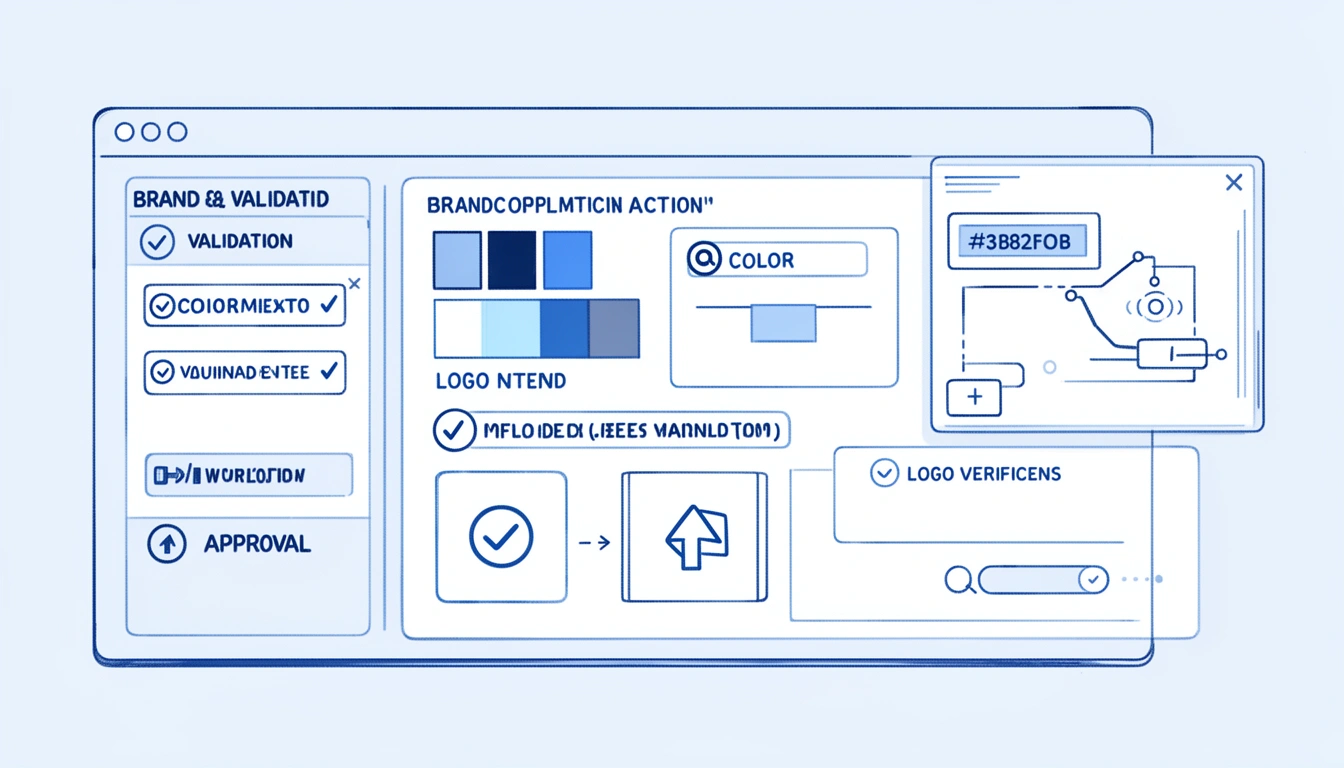
1. Real-Time Asset Validation
When a designer uploads a new asset or an AI tool generates content, compliance systems immediately scan for violations:
- Color matching against approved palettes (with tolerance thresholds)
- Logo detection and placement verification
- Font identification and usage validation
- Image quality checks (resolution, format, compression)
The system flags issues instantly "This blue (#2B5CE7) doesn't match our primary brand blue (#2A5CE6)" allowing creators to fix problems before they propagate.
2. Generative AI Guardrails
When using AI content generation tools, compliance systems act as governance layers that constrain outputs to brand-compliant options. Instead of reviewing AI-generated content after creation, you prevent off-brand outputs from being generated in the first place.
This is the approach that prevents AI slop and ensures every generated variant adheres to your brand's unique voice, visual style, and messaging frameworks.
3. Workflow Integration Checkpoints
Automated compliance doesn't just flag errors it integrates into your existing tools:
- Design software plugins: Real-time feedback within Figma, Adobe Creative Cloud, or Canva
- CMS validation: Pre-publish checks in WordPress, HubSpot, or custom publishing platforms
- Social media schedulers: Compliance verification before posts go to Buffer, Hootsuite, or native platforms
- Email builders: Template validation in Mailchimp, Klaviyo, or marketing automation tools
By meeting creators where they work, compliance becomes frictionless rather than obstructive.
4. Continuous Learning and Updates
When your brand guidelines evolve new colors, updated messaging, seasonal campaigns automated systems propagate changes instantly across all connected tools. No more hunting down every team member to announce updates or hoping they read the email.
This is the power of dynamic brand guidelines software that keeps your brand consistent across channels without manual intervention.
The Business Impact of Automated Compliance
Organizations implementing automated brand compliance report measurable benefits:
Speed to market: Reducing review cycles from days to minutes accelerates campaign launches. One retail brand cut time-to-publish by 73% after implementing automated checks.
Quality improvement: Automated systems catch errors humans miss especially in high-volume scenarios. Error rates drop by 60-80% when machines handle repetitive validation tasks.
Cost efficiency: A single compliance platform can replace the equivalent of 2-3 full-time reviewers, while improving consistency. The ROI becomes compelling within months.
Brand strength: Consistent execution builds brand recognition. When every touchpoint reinforces the same visual and verbal identity, brand recall increases by up to 80%.
Team empowerment: Creators get instant feedback instead of waiting for reviews. This autonomy increases job satisfaction while maintaining brand integrity.
Building Your Automated Compliance System
Implementing automated brand compliance requires both technology and strategy:
Step 1: Codify Your Brand Rules
Transform your static brand guide into executable rules. Instead of "use brand colors consistently," define: "Primary blue #2A5CE6 must appear in 40-60% of all marketing assets, with ±2% tolerance for color matching."
This process of creating centralized brand guidelines as a single source of truth is foundational to automation.
Step 2: Prioritize Compliance Checks
Not all violations are equal. Categorize rules by severity:
- Blocking errors: Wrong logo, illegal claims, prohibited imagery must be fixed before publication
- Warnings: Suboptimal color match, tone inconsistency flag for review but allow override
- Suggestions: Best practice recommendations educate without enforcing
This tiered approach prevents compliance fatigue while protecting critical brand elements.
Step 3: Integrate with Creation Tools
Deploy compliance checks where content is created, not as a separate review stage. Modern platforms offer APIs, plugins, and webhooks that embed validation into existing workflows.
For teams using AI content generation, this means treating your brand kit as an executable system that governs AI outputs in real-time.
Step 4: Establish Human Oversight
Automation handles repetitive checks, but human judgment remains essential for:
- Interpreting context and cultural nuances
- Approving creative risks that push boundaries strategically
- Updating rules based on market feedback and brand evolution
- Resolving edge cases the system can't categorize
The goal isn't eliminating human involvement it's elevating humans from rule enforcement to strategic brand stewardship. This human + AI collaboration creates the optimal balance.
Step 5: Monitor and Optimize
Track compliance metrics to identify patterns:
- Most common violations (signals unclear guidelines or inadequate training)
- Override rates (indicates rules may be too strict or context-dependent)
- Time saved vs. manual review (quantifies ROI)
- Error rates pre/post automation (demonstrates quality improvement)
Use these insights to refine rules, improve creator education, and prove the value of your compliance investment.
Common Challenges and Solutions
Challenge: "Our brand guidelines are too subjective to automate."
Solution: Start with objective elements (colors, logos, formats) and gradually codify subjective rules through examples and training data. AI models can learn tonal consistency from annotated content samples.
Challenge: "Creators will rebel against automated restrictions."
Solution: Frame compliance as enablement, not limitation. Fast, clear feedback helps creators work better. Involve creative teams in defining rules so they feel ownership rather than policing.
Challenge: "We need flexibility for different markets and campaigns."
Solution: Build contextual rulesets core non-negotiables plus flexible parameters for regional or campaign-specific variations. Modern systems support multiple brand profiles within a single platform.
Challenge: "Integration with our existing tools seems complex."
Solution: Start with one high-impact integration (e.g., your most-used design tool) and expand incrementally. Most compliance platforms offer pre-built connectors for popular marketing tools.
The Future of Brand Compliance
As AI content generation accelerates, automated compliance will evolve from competitive advantage to table stakes. We're moving toward:
Predictive compliance: Systems that anticipate brand risks before content is created, suggesting pre-approved templates and approaches.
Cross-platform governance: Unified compliance across websites, social media, print, video, audio, and emerging channels like AR/VR.
Self-improving systems: AI that learns from override patterns and audience response to refine rules automatically.
Compliance as differentiation: In an era of AI-generated content homogenization, rigorous brand compliance creates distinctive, memorable brand experiences that stand out.
Taking Action on Automated Compliance
The brands thriving in 2026 aren't choosing between speed and consistency they're using automation to achieve both. By implementing intelligent compliance systems, you:
- Protect brand equity while accelerating content velocity
- Empower creative teams with instant, actionable feedback
- Scale governance without proportionally scaling costs
- Build a sustainable foundation for AI-assisted content creation
The question isn't whether to automate brand compliance it's how quickly you can implement systems that turn your brand guidelines from static documentation into living, executable governance.
Because in a world where anyone can generate content at the click of a button, the brands that maintain distinctive, consistent identities across thousands of touchpoints will be the ones that win lasting customer recognition and loyalty.
Your brand deserves better than hoping people remember the rules. It deserves systems that enforce excellence automatically freeing your team to focus on strategy, creativity, and growth.