The Importance of Structure in AI Content Creation | BrandKit OS
AI hits a wall pretty fast if you don't have a system behind it. Unstructured prompts and scattered brand docs work for about ten outputs before quality drifts. Structure machine-readable brand data, governance rules, consistent inputs is the only thing that keeps AI content on-brand at volume. Without it, you aren't moving faster. You're just multiplying errors.
By July 2026, this gap is impossible to ignore. Brands are pumping out ten times more content through generative AI than they were two years ago, but they're feeding that AI the same unstructured PDFs and Google Docs from 2022. The disconnect between volume and quality is where brand drift, legal risk, and customer confusion live.
What "AI without architecture" actually means
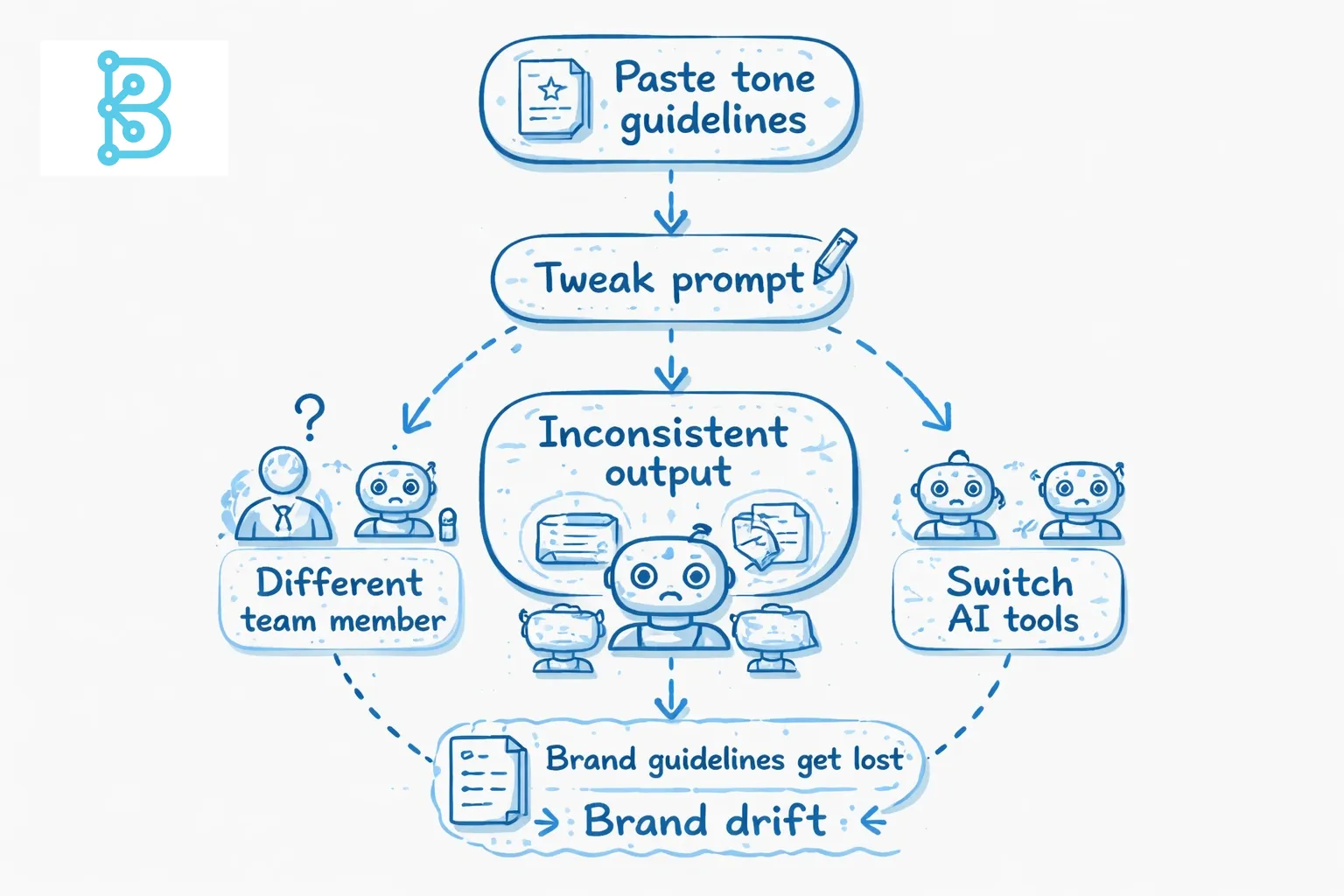
It’s the copy-paste workflow. You paste tone guidelines into ChatGPT, tweak a prompt, and hope for consistency. That hope usually dies the moment a second team member gets involved or you switch AI tools.
The symptoms are obvious. One writer's "friendly but authoritative" becomes another's "casual and chatty." A logo rule buried on page 14 of a PDF never makes it into a designer's prompt. Every session starts from zero because there's no persistent memory of what the brand is.
This isn't a tooling problem. It's an architecture problem. Teams adopted the workflows without building the foundations.
The ceiling every team hits
The breaking point arrives when content volume outpaces your ability to review it. You can catch brand violations in five pieces of content. You can't catch them in fifty. Past that threshold, quality control either collapses or gets skipped entirely.
You know you've hit it when:
- Marketing and design teams argue over which brand guide is current.
- AI drafts require heavier edits than human-written ones.
- Agencies have to re-explain brand rules for every single campaign.
- Growth teams ship faster but convert worse because the copy sounds generic.
- Compliance teams flag violations after publication.
These aren't AI problems. They're structural gaps that AI exposes. The tool doesn't create inconsistency it just executes inconsistent instructions at a speed that turns small cracks into canyons.
Structure as infrastructure, not documentation
Structure means treating brand identity as a system of machine-readable fields, not a static PDF. Voice, tone, color, typography, and governance rules become discrete, queryable data points. AI tools pull exactly what they need without a human translating a PDF into a prompt every time.
That's the difference between a brand guide and brand infrastructure. A guide is read once and forgotten. Infrastructure is queried constantly. When a rule changes, every downstream output inherits it automatically no re-training, no re-briefing.
Brand Kit OS was built on this premise: brand kits work best as APIs, not PDFs. You can see how this plays out on the features page, where extraction, structuring, and export are one continuous pipeline, not three separate tools.
What structured brand architecture looks like
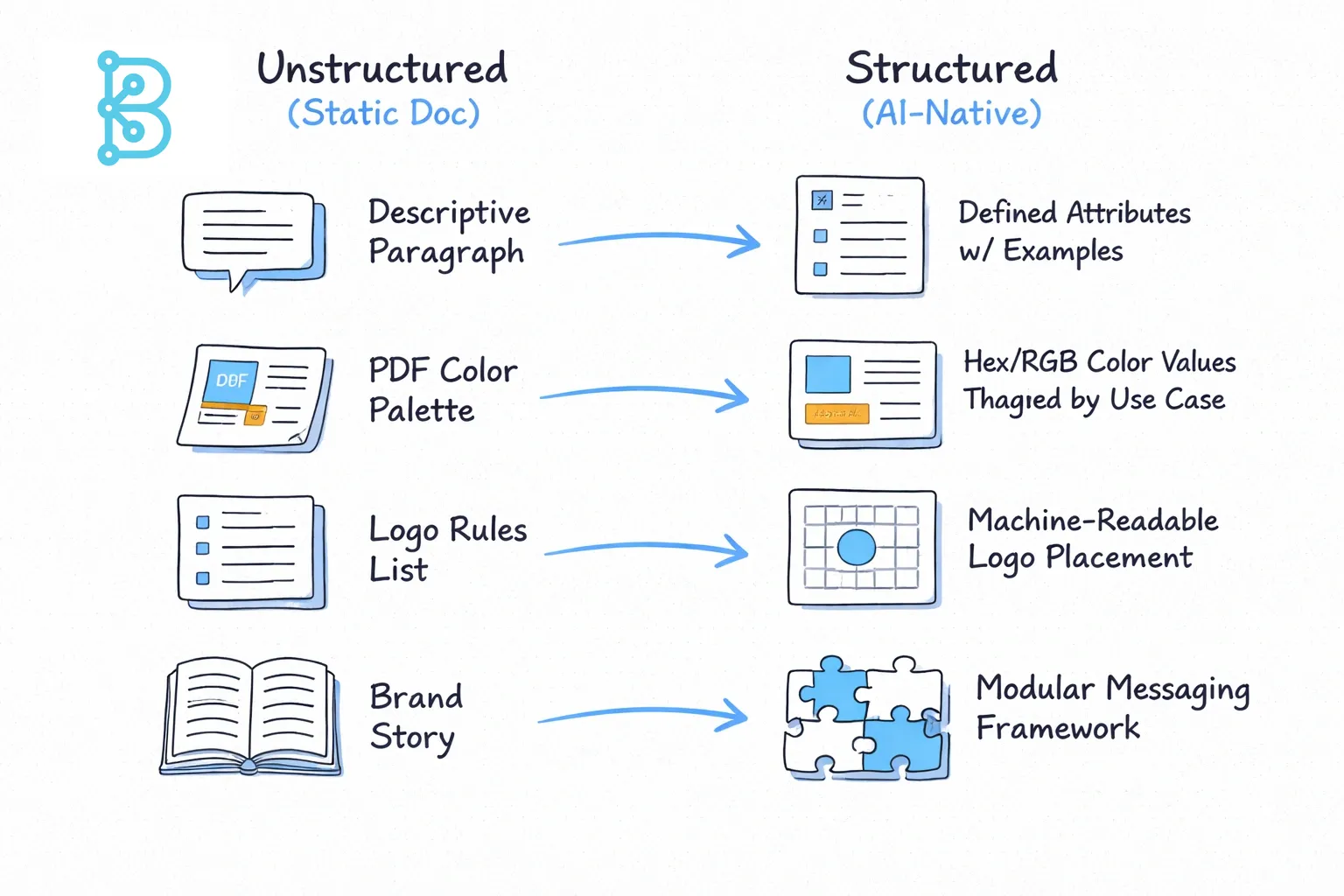
Organizing brand elements into fields an AI can parse rather than paragraphs a human has to interpret is measurable. Structured fields produce consistent outputs. Unstructured paragraphs produce a new interpretation every time.
| Element | Unstructured (Static Doc) | Structured (AI-Native) |
|---|---|---|
| Voice & Tone | Descriptive paragraph, open to interpretation | Defined attributes with examples and anti-examples |
| Color Palette | Swatches in a PDF | Hex/RGB values tagged by use case |
| Logo Rules | Do's and don'ts list | Machine-readable placement and spacing rules |
| Messaging | General brand story | Modular framework by audience segment |
| Compliance | Manual review checklist | Real-time automated flagging |
| Distribution | Shared drive link | Export to Markdown, Claude, ChatGPT, or MCP |
Teams that document this way stop losing time re-explaining basics. New hires and AI tools onboard against the same structured source, not a patchwork of Slack messages and outdated files.
How governance prevents homogenization
Governance bridges the gap between structured data and safe output. Structure tells the AI what the brand looks like. Governance tells it what's allowed, what's flagged, and what needs human eyes before publishing.
Generic LLMs tend toward the average. Left unchecked, they push every brand toward the same safe, familiar phrasing. That's a real risk when competitors use the same underlying models. Governance rules act as a counterweight, enforcing style precedence so brand rules override generic defaults, flagging errors in real time, inserting human checkpoints for high-risk content, and creating audit trails for approvals.
That's how AI governance for brand consistency becomes infrastructure, not a nice-to-have. Without it, structure just produces faster mistakes.
Building the architecture: A practical sequence
You can't skip steps. The sequence is extract, structure, govern, deploy. Miss one, and you recreate the same ceiling with a different tool.
Extract. Pull signals from your website, social profiles, and current assets. Don't start from scratch. Surface the brand as it actually exists.
Structure. Organize those signals into defined fields voice, visual system, messaging that AI can parse directly. This is the step everyone skips. It's the one that matters most.
Govern. Layer in rules for precedence, escalation, and review. This is what separates fast from reckless.
Deploy. Export the data into the tools your team uses Claude projects, ChatGPT instructions, or a direct connection via MCP documentation. In 2026, teams building around Model Context Protocol connections are making this the norm.
The full pipeline field structure, export formats, integration points is in the documentation.
Who feels the ceiling first
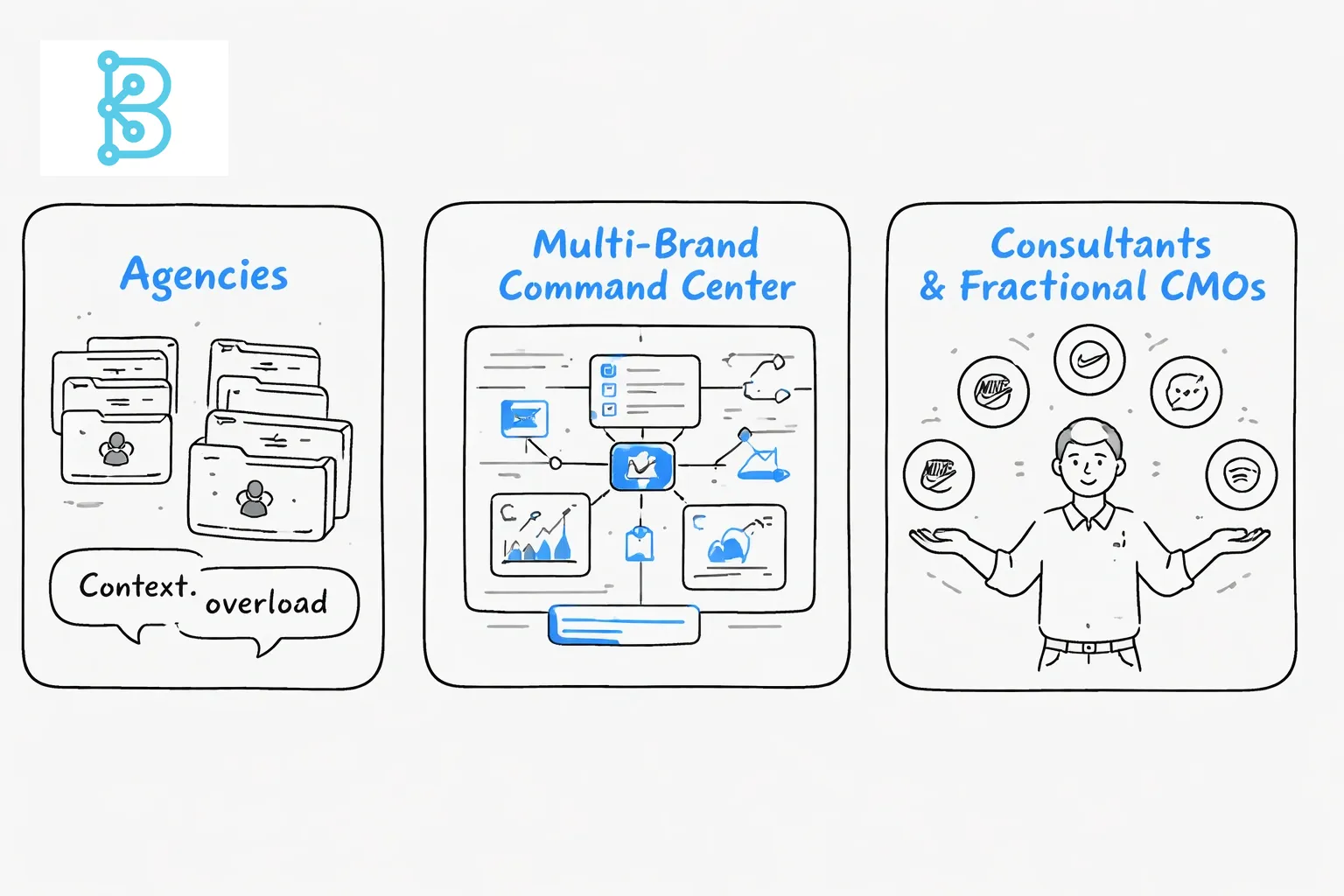
Agencies, consultants, and growth teams hit the wall first. They produce the most content per headcount. Their bottleneck isn't creativity. It's context.
Agencies managing multiple clients feel this acutely. Every new client means re-learning a voice, a palette, and a set of rules from memory or a scattered folder. The agencies solution page addresses this directly: a multi-brand command center replaces the mental overhead of switching between identities.
Solo consultants and fractional CMOs face a sharper version of the problem. One person, many clients, no room for slow onboarding. The consultants solution page is built around that constraint fast structuring, fast switching.
Growth teams feel it as an ROI problem. More AI content should mean more output per dollar. Without structure, it just means more review hours. The growth teams solution page frames this as future-proofing scaling without adding headcount.
The ROI case for structure
Structure pays for itself in avoided rework. Every hour spent re-explaining brand rules to a new AI session is an hour not spent on strategy. That math compounds.
The gains stack up: onboarding in minutes, not weeks; first-pass AI output that doesn't need three revision cycles; automated flagging that catches issues before the client sees them; more content velocity without losing fidelity.
If you're comparing platforms, the Frontify alternative comparison is a useful reference if you're paying five figures a year for a static portal.
Pricing reflects the shift: structured, AI-native brand management starts at a fraction of legacy DAM costs. Details are on the pricing page.
Getting started without overbuilding
You don't need a six-month overhaul. You need one structured source of truth that every AI tool can pull from. Build it incrementally.
Start with the highest-friction area usually voice and tone, since that drifts fastest. Add visual rules. Layer in governance once the structure holds. If you're not sure where you're losing time, check the FAQ or glossary before you rebuild anything.
Security is a legitimate concern when centralizing assets. Review the security page before committing your library.
The ceiling on AI-without-architecture isn't a glitch teams will grow out of. It's a structural limit that gets worse as AI adoption grows. Structure turns AI from a volume tool into an advantage and it's a lot easier to build before the backlog piles up.