Messaging Framework Wizard: AI Copywriting Playbooks
Your brand guidelines live in a static PDF. Your copywriters and AI tools need dynamic instructions. This disconnect creates inconsistent messaging that dilutes your brand voice across every touchpoint.
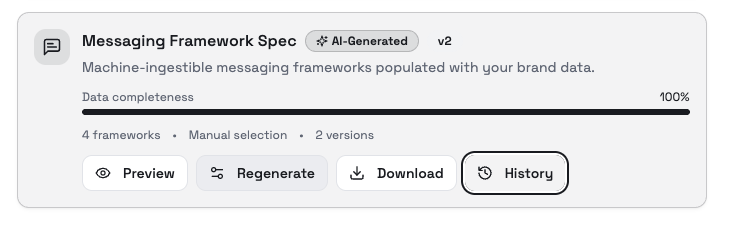
The new Messaging Framework Document Creation Wizard in Brand Kit OS transforms your brand data into 22 pre-populated copywriting playbooks, bridging the gap between brand identity and executable messaging strategies that your entire team can use.
The Hidden Cost of Static Brand Guidelines
Most brand kits include a section on "tone of voice" with adjectives like "friendly," "professional," or "innovative." While helpful for general direction, these descriptions fail when your team sits down to write actual content.
Consider what happens when you task someone with creating a landing page:
Your marketing manager interprets "friendly" as casual and conversational
Your AI assistant generates generic, safe copy that sounds like everyone else
Your freelance copywriter applies their own interpretation based on past clients
The result? Three completely different messages for the same product, none of which consistently reflect your brand's unique positioning. Teams waste hours in revision cycles, and AI tools require constant re-prompting with brand context.
From Brand Identity to Messaging Playbooks
The Messaging Framework Specification solves this by converting your Brand Kit OS data personas, pain points, value propositions, and tone guidelines into 22 professional copywriting frameworks that are pre-filled with your specific brand information.
Instead of starting from scratch with a blank AIDA or PASTOR framework, your team gets a customized template that already knows:
Your target audience's specific pain points and desires
Your product's unique value propositions and differentiation
Your brand's approved tone, voice characteristics, and messaging guardrails
Real examples from your existing high-performing content
This transforms abstract frameworks into concrete, brand-specific copywriting playbooks that anyone human or AI can follow.
22 Frameworks for Every Marketing Scenario
The wizard includes comprehensive coverage of professional messaging frameworks, each optimized for different content types and emotional contexts:
High-Conversion Sales Copy
PASTOR Framework (Problem, Amplify, Story, Testimony, Offer, Response) works exceptionally well for sales pages where you need to build credibility while addressing pain points. The wizard populates this with your customer stories, product benefits, and specific objections your audience faces.
Problem-Agitate-Solve serves cold outreach and direct response campaigns. By pre-loading your prospect's challenges and your solution's unique mechanism, you ensure every outreach email maintains brand consistency while hitting psychological triggers.
Educational and Nurture Content
Before-After-Bridge excels in blog posts, case studies, and content marketing. Your Messaging Framework Specification automatically fills in the "before" state with your persona's pain points, the "after" state with transformation outcomes, and the "bridge" with your methodology.
Friend-Expert Balance helps create guides and how-to content that's approachable yet authoritative, critical for thought leadership that doesn't feel salesy.
Positioning and Differentiation
Star-Story-Solution works for founder stories and brand narratives. The wizard incorporates your brand's origin story, mission, and unique approach to create a consistent narrative across all storytelling touchpoints.
Unique Mechanism Positioning helps you articulate what makes your solution different not just better. This framework gets populated with your proprietary processes, technology advantages, or methodological innovations.
Objection Handling
Five Basic Objections (too expensive, doesn't work, doesn't work for me, can wait, too hard) provides pre-written responses based on your product's actual pricing, proof points, and implementation process perfect for FAQ pages and sales enablement.
How AI Generation Creates Your Custom Playbooks
The wizard analyzes your existing Brand Kit OS content to automatically generate framework-specific messaging:
Asset Analysis: The AI scans your uploaded brand documents, website content, and past campaigns to extract key themes, language patterns, and successful messaging angles
Framework Mapping: For each of the 22 frameworks, the system maps your brand data to the appropriate framework components (e.g., your customer pain points become the "Problem" in PASTOR)
Voice Calibration: Using your tone guidelines and approved content examples, the AI calibrates each framework to match your brand voice whether that's technical and precise or warm and conversational
Validation: Built-in compliance checks ensure generated frameworks align with your brand rules, avoiding off-brand language or positioning
The result is a comprehensive Messaging Framework Specification document that serves as your team's single source of truth for copywriting compatible with both human writers and AI assistants.
Integrating with AI Content Workflows
The real power emerges when you connect your Messaging Framework Specification to AI content creation tools. Similar to how Claude Skill Export transforms brand guidelines into AI, this specification provides AI models with structured, actionable instructions.
When you export your Messaging Framework Specification:
ChatGPT Custom Instructions can reference specific frameworks for different content types
Claude Projects gain access to your complete messaging playbook as knowledge
Content generation APIs receive structured data that ensures brand consistency at scale
Instead of prompting "write this in our brand voice," you can instruct: "Use the PASTOR framework from our Messaging Specification for this product launch page." The AI immediately understands your target audience, pain points, social proof, and call-to-action all calibrated to your brand.
This approach prevents the generic, homogenized content that plagues AI-generated copy. Your messaging remains distinctly yours because the frameworks themselves are customized with your proprietary brand data.
Solving Multi-Channel Consistency Challenges
Growing brands face messaging chaos across channels. Your email team uses one approach, your social media manager another, and your paid ads specialist yet another interpretation of your brand voice.
The Messaging Framework Specification creates alignment by giving each channel team the appropriate framework for their medium:
Email campaigns: AIDA or Problem-Agitate-Solve for different funnel stages
Landing pages: Picture-Promise-Prove-Push for conversion optimization
Social media: Emotion-Logic or Personal-Universal for engagement
Pricing pages: Five Basic Objections or Solution-Savings-Social Proof
Each team gets the right framework for their needs, but all frameworks draw from the same brand data foundation. This ensures tonal consistency even when the structure adapts to different formats.
For teams leveraging visual and voice references for AI content generation, the Messaging Framework Specification adds the copywriting layer completing the full brand consistency stack across written, visual, and audio modalities.
Real-World Application: From Framework to Finished Copy
Let's walk through how a marketing team uses the Messaging Framework Specification:
Scenario: Your company needs to create a cold email campaign targeting enterprise clients.
Without the Specification: Your copywriter asks for background, reviews old campaigns, makes assumptions about pain points, writes a draft, gets feedback that "it doesn't sound like us," and goes through three revision rounds.
With the Specification:
Team selects the Problem-Agitate-Solve framework (optimized for cold outreach)
Opens the pre-populated template showing:
Problem: "Enterprise teams waste 40+ hours monthly on manual brand compliance checks"
Agitate: "Every missed logo misuse or off-brand social post damages trust with your audience and creates legal exposure"
Solve: "Brand Kit OS automates compliance in real-time, flagging errors before they go live saving your team time and protecting brand equity"
Copywriter or AI tool adapts the framework to the specific campaign while maintaining approved messaging
First draft is 90% on-brand, requiring minimal revision
Time saved: 6-8 hours per campaign. Quality improvement: consistent brand voice from the first draft.
Governance for High-Velocity Content Production
As content velocity increases especially with AI assistance traditional review processes break down. You can't manually review hundreds of social posts, email variations, and ad copies without becoming a bottleneck.
The Messaging Framework Specification enables governance at scale by:
Establishing clear parameters: Each framework defines what's on-brand for that content type
Providing reference standards: Teams can self-check against approved messaging patterns
Enabling automated compliance: AI tools can validate content against framework specifications before human review
This shifts your brand management from reactive policing to proactive enablement. Instead of catching mistakes after creation, you prevent them by giving creators better tools upfront.
For organizations dealing with AI-generated content governance challenges, this specification layer provides the structure needed to maintain quality while scaling production a critical advantage as content demands continue accelerating in 2026.
Customization and Iteration
While the wizard generates your initial Messaging Framework Specification automatically, Brand Kit OS recognizes that messaging evolves. The platform allows you to:
Edit framework components: Refine pain points, adjust value propositions, or update proof points as your product and market evolve
Add custom frameworks: Include proprietary messaging structures unique to your organization
Version control: Track changes over time and maintain historical specifications for different product launches or campaigns
A/B test variations: Create framework variants for testing different messaging approaches while staying within brand guidelines
This flexibility ensures your Messaging Framework Specification remains a living document that grows with your brand rather than becoming another outdated PDF.
Integration with Your Brand Kit Ecosystem
The Messaging Framework Specification doesn't exist in isolation it's part of your comprehensive Brand Kit OS system:
Visual assets: Your logos, colors, and design templates
Voice guidelines: Tone characteristics and language preferences
Messaging frameworks: Copywriting playbooks for different scenarios
Content examples: Approved samples demonstrating guidelines in action
Together, these components create a complete brand system that's accessible as an API for both human teams and AI agents. When you create content, you're not just guessing at brand voice you're executing against a documented, tested framework.
This systematic approach transforms brand management from an art into a repeatable science, enabling consistency across teams, tools, and time.
Getting Started with the Wizard
Creating your Messaging Framework Specification requires minimal effort thanks to AI automation:
Launch the wizard from your Brand Kit OS dashboard
Select frameworks most relevant to your content needs (or include all 22)
Review AI-generated content for each framework component
Refine and approve the specification
Export and distribute to your team and AI tools
The entire process takes 30-45 minutes a fraction of the time required to create comprehensive copywriting guidelines manually.
The Future of Brand-Consistent Copywriting
As we move deeper into 2026, the volume of marketing content continues to explode. Brands are producing 10x the content they created five years ago, much of it AI-assisted. In this environment, maintaining a distinctive brand voice becomes both harder and more important.
The Messaging Framework Document Creation Wizard represents the evolution of brand management from static guidelines to executable systems. Your brand voice isn't just described it's encoded into frameworks that anyone can use to create on-brand content consistently.
This shift from description to execution is what separates brands that maintain coherence at scale from those that fragment into inconsistency. When your messaging frameworks are as accessible and actionable as your logo files, brand consistency becomes achievable across every touchpoint.
Whether you're a startup establishing your first comprehensive brand system or an enterprise managing messaging across global teams, the Messaging Framework Specification provides the structure needed to scale your brand voice without sacrificing what makes it uniquely yours.