Breaking AI-Generated Branding Floor | BrandKit OS
It’s July 2026. Open any AI image generator and you’ll see the same problem. Soft gradients. Generic sans-serif logos. That same "friendly startup" illustration style. It’s called the aesthetic floor problem, and it’s quietly flattening brand identity across every industry.
The stakes go beyond ugly art. When AI tools default to statistically "safe" outputs, brands lose the edge that makes them memorable. Marketing teams relying on generic prompts produce content that looks exactly like their competitors', eroding brand equity while volume goes up. If you’re an agency managing dozens of clients, this is a crisis.
What is the aesthetic floor problem?
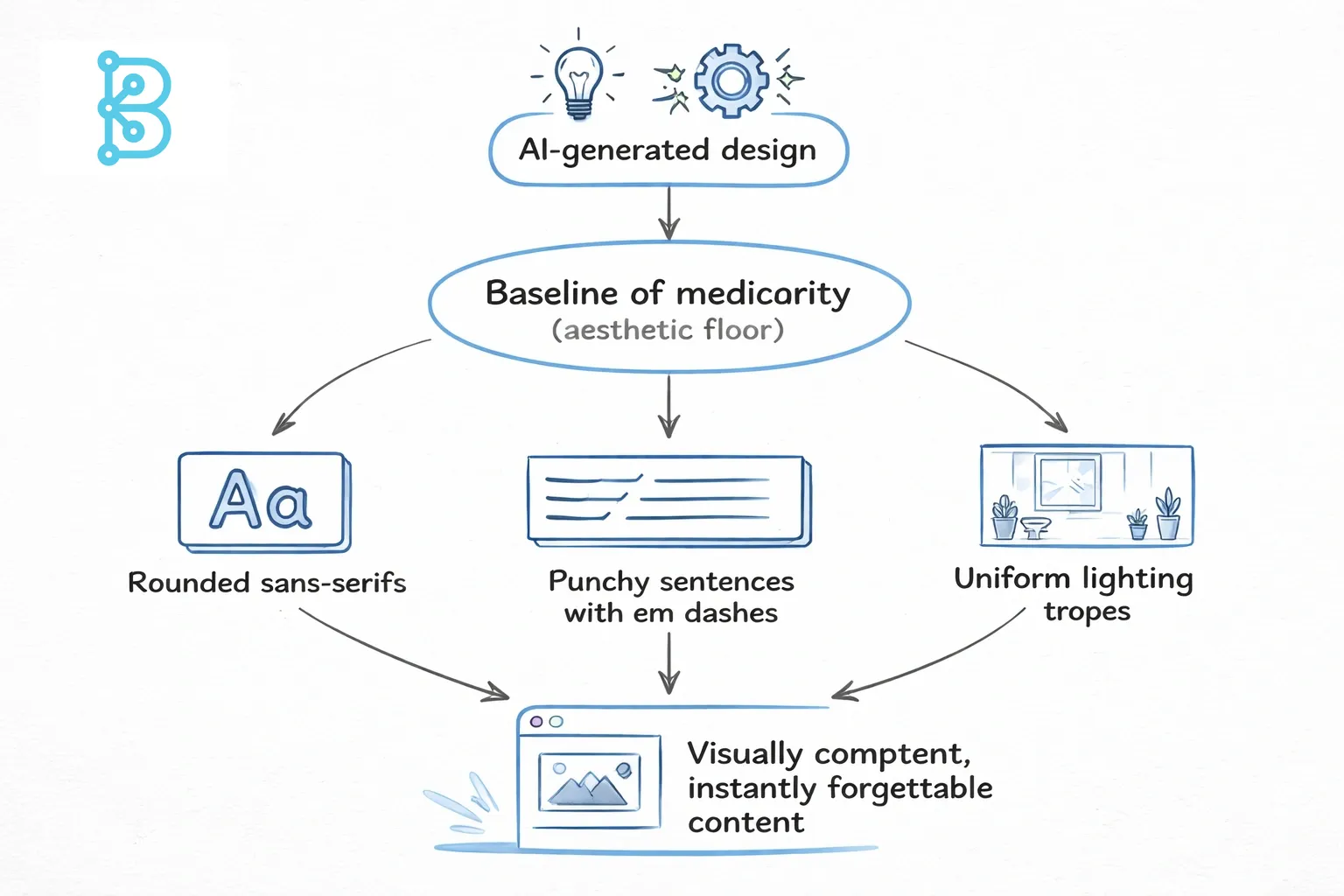
The aesthetic floor is the baseline of mediocrity AI naturally gravitates toward. Generative models train on massive datasets, so they inevitably drift toward the statistical mean of "good design." The result? Visually competent, instantly forgettable content.
This isn’t a bug. It’s how the models work. They predict the most probable next pixel or word based on training data. Without explicit constraints, probability defaults to the average. That’s why AI logos love rounded sans-serifs, why AI copy leans on em dashes and punchy sentences, and why images share the same lighting tropes.
Think of it like tap water versus a signature cocktail. Tap water is safe and functional, but nobody remembers it. A cocktail needs specific ingredients and ratios the kind of specificity a generic prompt never provides.
Why AI models default to sameness
AI optimizes for plausibility, not distinctiveness. It picks the most common patterns in its training data. You end up with content that’s technically correct but strategically invisible.
Three technical reasons drive this. Training data bias means popular trends swamp datasets, so models overrepresent them. Prompt vagueness like "modern logo for a tech company" invites generic output. Most teams also lack a governance layer, using raw tools without structured brand rules.
Marketing teams often think the fix is a better prompt. That helps, but it doesn’t solve a structural issue. You can’t prevent AI slop by asking nicely; you have to feed models persistent, structured brand context. Read more on how to prevent AI slop and generate on-brand content for the technical breakdown.
The business cost of homogenized branding
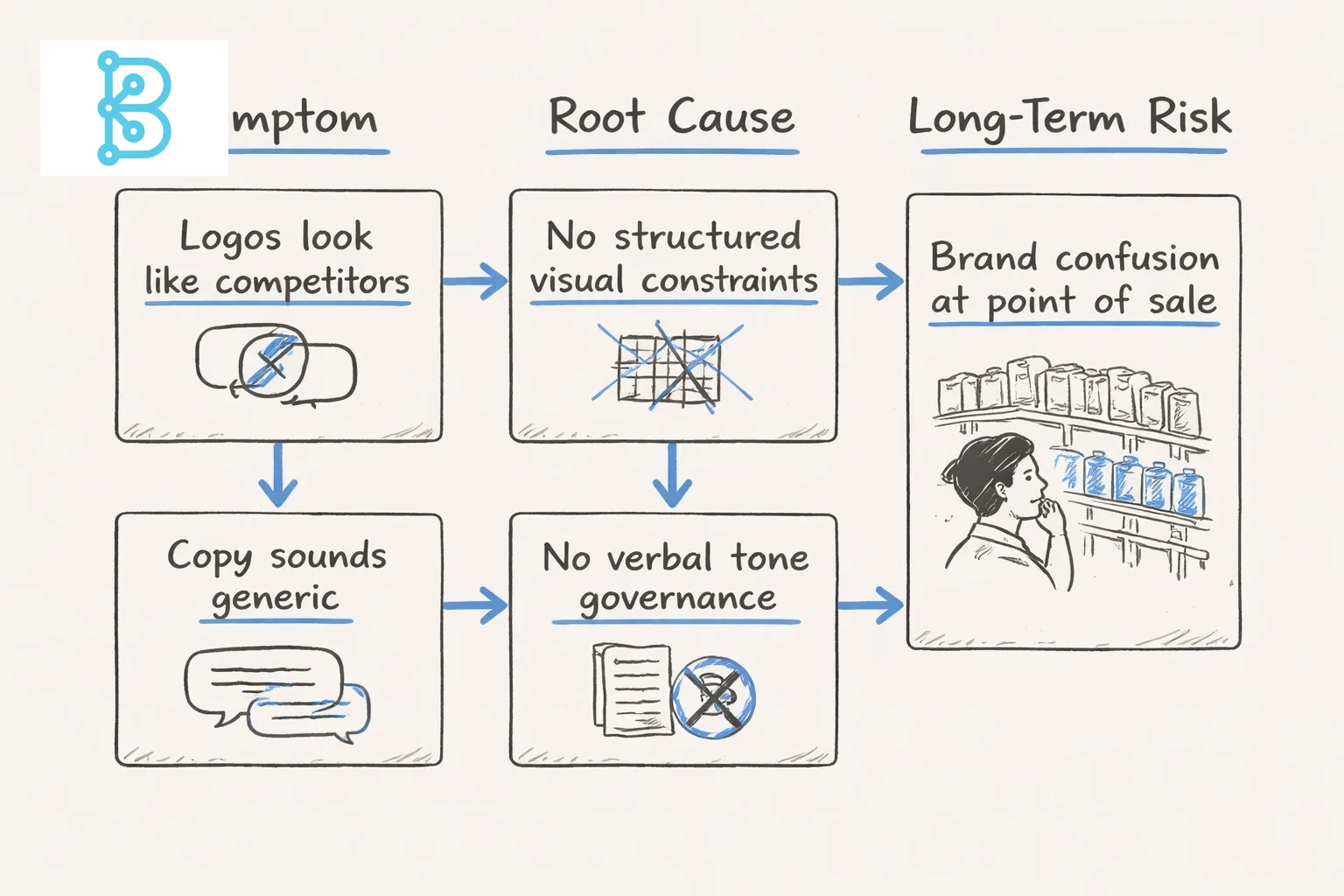
When your visuals and voice look like everyone else’s, customers scroll past. You lose recognition, recall, and pricing power. It gets worse as you ramp up content velocity.
The math is uncomfortable. Brands that differentiated visually and verbally in the 2026 positioning playbook saw better recall. Brands relying on default AI outputs saw flatter engagement despite higher volume. Volume without distinctiveness is a trap.
| Symptom | Root Cause | Long-Term Risk |
|---|---|---|
| Logos look like competitors' | No structured visual constraints | Brand confusion at point of sale |
| Copy sounds generic | No verbal tone governance | Reduced perceived authority |
| Social content blends into feed | No proprietary style rules | Lower recall, lower CTR |
| Multiple teams produce different "voices" | No centralized brand source | Internal and external inconsistency |
Brand drift is being called the new technical debt for a reason it piles up quietly until it’s expensive to fix.
How structured brand data breaks the floor
You break the floor by giving AI explicit constraints, not vague suggestions. When color values, typography rules, and tone parameters feed directly into workflows, AI stops defaulting to the mean.
This is the shift from static guides to executable systems. A PDF guideline is useless to an AI. A structured brand kit exported as Markdown, JSON, or via API can actually do the work. Brand Kit OS treats the brand kit as a governance layer, not a reference doc, which is why dynamic brand guidelines software is becoming essential infrastructure.
Mechanisms that actually work include negative directories that explicitly tell AI what your brand never does, style precedence rules that define which elements override defaults, and persona-specific tone overrides so copy sounds like you. RAG-ready knowledge files also feed brand voice directly into retrieval pipelines.
Building an AI-resistant brand identity
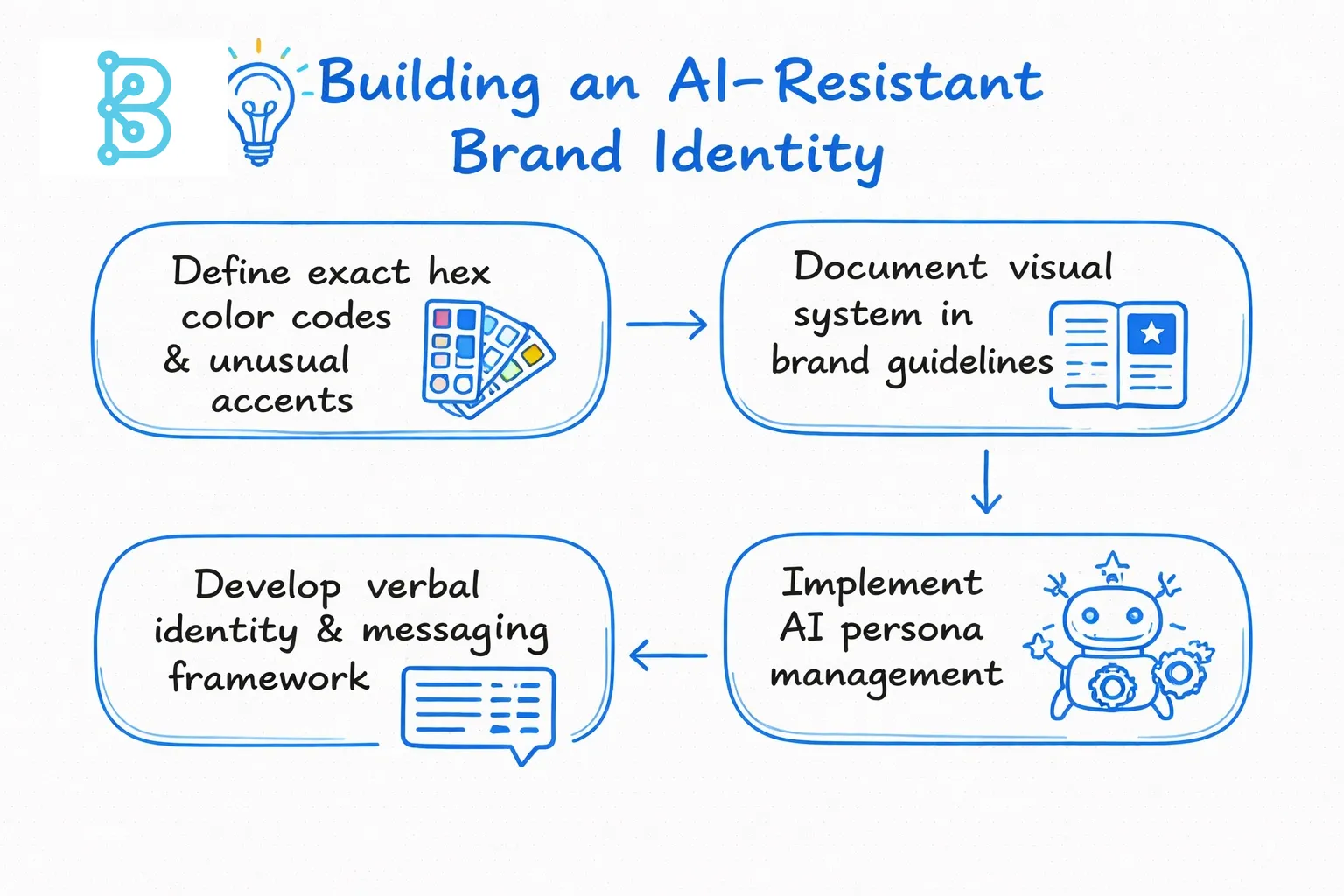
An AI-resistant identity is deliberately specific. It uses color combinations, typography pairings, and verbal quirks that AI wouldn’t pick by default. Specificity is the antidote to averaging.
Start with your visual system. Instead of "blue and white, modern," define exact hex codes and unusual accents. Document this inside a centralized brand guidelines system so it’s referenced, not reinvented.
Next, fix your verbal identity. Most brands under-invest here. A solid messaging framework captures sentence rhythm and banned phrases details generic prompting misses. Layer in AI persona management so different content types keep distinct but on-brand voices.
Finally, treat your brand kit as a living system. Guidelines should evolve, which is why structuring guidelines for AI compliance matters more in 2026 than ever.
Governance-first workflows for agencies and growth teams
Governance-first workflows embed brand rules into every AI interaction. Instead of relying on individual prompt skill, teams centralize brand data so consistency is automatic.
Agencies feel this acutely. Five team members using five tools produce five different interpretations of "on-brand." Brand Kit OS was built for this see how it supports agencies managing multiple client brands with a single command center.
Growth teams face a parallel challenge: velocity outpaces review. Automated compliance checks catch off-brand elements before publication, core to automated brand compliance at scale. This separates brands using AI for differentiation from those using it for homogenization.
Consultants benefit too. Context-switching between client voices is exhausting without a structured system. See how consultants manage brand ops without losing voice or time across multiple accounts.
Practical steps to escape the floor this quarter
Escaping the floor requires structured input, not better prompt luck. Audit outputs, document constraints, and connect them directly into workflows.
Here’s a sequence for July 2026. Audit your last 30 days of AI content and flag anything that could belong to a competitor. Document explicit visual constraints exact colors, type pairings, layout rules inside a structured digital brand kit. Write a negative directory listing phrases, colors, and layouts your brand never uses. Export brand data in AI-readable formats; Markdown and RAG-ready files outperform PDFs for every tool. Set up MCP or API connections where available so brand data feeds AI agents automatically see the MCP documentation for details. Finally, review outputs regularly. Governance isn’t set-and-forget; it’s a checkpoint against drift.
Teams following this report faster cycles and stronger differentiation. Governance and velocity aren’t opposing goals.
The floor is rising don’t get stuck below it
The aesthetic floor keeps climbing as more brands adopt generative AI without governance. Every unchecked output that resembles a competitor’s raises the average and lowers the bar for what customers notice. Brands that invest in structured, AI-readable systems now will be the distinctive voices left standing once the floor becomes the ceiling.
Brand Kit OS was built for this moment treating your brand kit as an API that feeds every tool with specificity. Explore the features page to see how it works in practice, or check the pricing page to find the right plan.