Brand Compliance Guide: Automate Consistency in 2026
Brand compliance isn't just about enforcing rules it's about protecting the equity you've built while enabling creativity at scale. In 2026, as AI-generated content floods every channel and teams produce materials at unprecedented velocity, the cost of off-brand moments has never been higher. A single misaligned color palette, inconsistent logo usage, or tone-deaf message can erode customer trust built over years.
The challenge? Traditional brand compliance methods manual review queues, static PDF guidelines, and post-production audits simply can't keep pace with modern content demands. This guide explores how forward-thinking brands are transforming compliance from a bottleneck into a competitive advantage through intelligent automation and governance.
The True Cost of Brand Inconsistency
Before diving into solutions, it's worth understanding what's at stake. Brand inconsistency manifests in ways both obvious and subtle:
Diluted recognition: When your logo appears in 12 different color variations across channels, customers subconsciously question your professionalism
Wasted resources: Teams spend an average of 8-15 hours per week searching for approved assets or recreating materials that already exist
Legal exposure: Unapproved claims, outdated compliance language, or misused trademarks can trigger regulatory issues or litigation
Lost revenue: Research consistently shows that consistent brand presentation increases revenue by an average of 23%
In the AI era, these risks multiply. When a marketing coordinator can generate 50 social posts in an afternoon using generative AI, even a 5% error rate means multiple off-brand outputs reaching audiences daily.
Why Legacy Compliance Approaches Fail
Most organizations approach brand compliance through one of these outdated models:
The Gatekeeper Model
A small brand team reviews every asset before publication. This ensures quality but creates devastating bottlenecks. When your review queue is 200 assets deep and growing, either content velocity suffers or reviewers start rubber-stamping approvals to keep pace.
The PDF Guideline Model
Teams distribute a comprehensive brand guide and hope people read it. Reality check: that 87-page document gets downloaded, filed away, and never referenced. Even well-intentioned team members can't remember whether the secondary CTA button uses #2E5BFF or #2F5CFF when they're rushing to finish a campaign.
The Training Model
Organizations invest in extensive onboarding and periodic refresher training. While valuable, knowledge degrades over time, new tools introduce new complexity, and high turnover means constant re-training cycles.
None of these models were designed for a world where AI-generated content allows individual contributors to produce what entire creative teams used to handle.
The Shift to Automated Brand Compliance
Progressive brands are reimagining compliance as an automated system that provides real-time guidance rather than post-production judgment. This shift involves three fundamental changes:
1. Preventive vs. Detective Controls
Instead of catching errors after they happen, intelligent systems prevent them from occurring. Imagine a designer selecting a color rather than hoping they remember the approved palette, the design tool only offers approved options. Or a copywriter drafting messaging who receives instant feedback when their tone drifts from brand voice guidelines.
This preventive approach eliminates the adversarial dynamic where creative teams feel policed by brand guardians. The system becomes a helpful co-pilot rather than a critical supervisor.
2. Executable Rules vs. Written Guidelines
The most transformative change is treating brand guidelines as executable code rather than reference documents. Your brand rules become programmatic APIs that systems can query in real-time.
For example, instead of a guideline stating "Use Montserrat Bold for headlines, 18-24pt," that rule becomes machine-readable logic that automatically formats headlines correctly across every touchpoint. When integrated with automated brand compliance platforms, these executable rules scale infinitely without human intervention.
3. Continuous vs. Periodic Enforcement
Traditional compliance happens in batches quarterly audits, campaign reviews, or annual guideline updates. Modern compliance is continuous, with systems constantly monitoring outputs and flagging deviations instantly.
This creates a feedback loop where brand teams identify systemic issues faster and teams learn compliance through immediate correction rather than delayed critique.
Understanding Brand Audits: The Foundation of Effective Compliance
Before you can automate compliance, you need to know where you stand. A comprehensive brand audit serves as the diagnostic that reveals gaps between your intended brand standards and actual execution across all touchpoints. This foundational assessment identifies inconsistencies in visual identity, messaging, customer experience, and brand perception that your compliance systems need to address.
Whether you're launching a new compliance initiative or refining an existing one, conducting a thorough brand audit provides the baseline data you need to prioritize automation efforts, measure improvement, and ensure your compliance rules reflect actual brand standards. Regular audits also help you identify emerging inconsistencies before they become systemic problems, making them an essential component of any mature brand governance program.
Core Components of Intelligent Compliance Systems
Building effective automated compliance requires several integrated capabilities:
Centralized Asset Repository
Every approved brand asset logos, templates, imagery, copy snippets, color codes, font files lives in a single source of truth. This isn't just storage; it's an intelligent library that understands relationships, usage contexts, and approval status.
When someone searches for "logo," they don't get 47 variations of unknown provenance. They get the current approved version with clear usage guidelines and format options. Centralized brand guidelines eliminate the ambiguity that causes compliance drift.
Real-Time Validation Engine
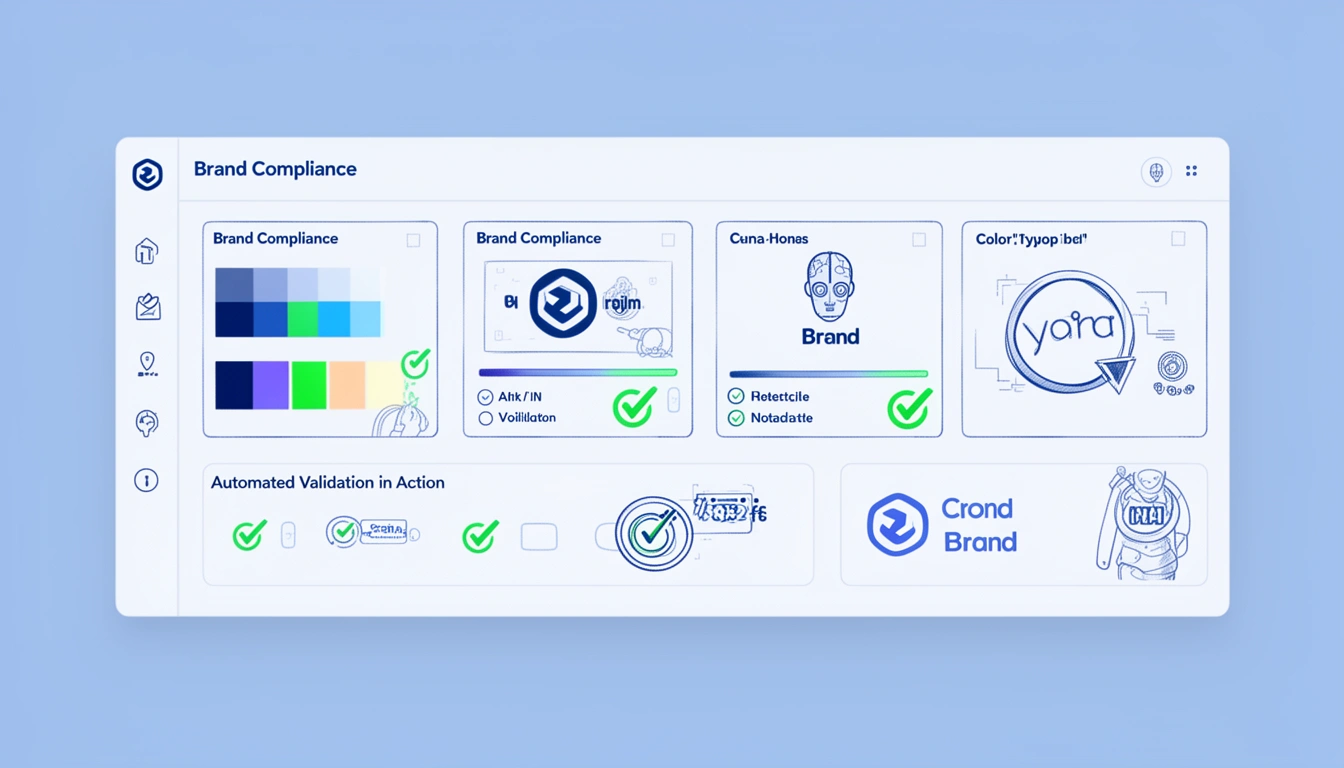
As content is created, automated checks validate compliance across multiple dimensions:
Visual compliance: Logo placement, color accuracy, typography, spacing, image treatment
Verbal compliance: Tone of voice, prohibited language, required disclosures, messaging consistency
Legal compliance: Trademark usage, copyright attribution, regulatory requirements, claim substantiation
Channel compliance: Format specifications, technical requirements, platform-specific guidelines
The validation engine doesn't just flag errors it suggests corrections, explains why something violates guidelines, and offers approved alternatives.
Integration Architecture
Compliance systems must integrate with the tools teams actually use. This means connections to:
Design platforms (Figma, Adobe Creative Suite)
Content management systems (WordPress, Contentful)
Marketing automation (HubSpot, Marketo)
Social media management (Hootsuite, Sprout Social)
AI content tools (ChatGPT, Jasper, Midjourney)
Compliance embedded in existing workflows succeeds; compliance that requires workflow disruption gets ignored.
Governance Layer
Not all compliance violations are equal. Intelligent systems understand severity levels and route accordingly:
Auto-fix: Minor issues like incorrect hex codes get automatically corrected
Warning: Questionable choices trigger alerts but allow override with acknowledgment
Block: Critical violations prevent publication until resolved
Escalate: Complex scenarios route to appropriate reviewers
This nuanced approach maintains velocity while protecting brand integrity where it matters most.
Choosing the Right Brand Compliance Marketing Software
With the compliance landscape evolving rapidly, selecting the right technology platform has become critical. The software you choose will determine how effectively you can automate compliance workflows, integrate with existing tools, and scale your brand governance.
Modern brand compliance marketing software goes beyond simple asset management to provide intelligent validation, real-time feedback, and seamless integration across your entire marketing technology stack. The best platforms combine centralized brand guidelines, automated checking capabilities, and flexible governance workflows that adapt to your organization's specific needs.
When evaluating solutions, consider not just current capabilities but how well the platform can evolve with emerging compliance challenges like AI-generated content validation, multi-modal consistency checking, and predictive compliance analytics.
Automating Compliance with Brand Proofing Software
One of the most effective ways to operationalize compliance is through dedicated brand proofing software that automates the review and validation process. Rather than relying on manual checks that slow down production, brand proofing software automatically scans assets against your brand standards before they reach human reviewers.
This technology acts as a first line of defense, catching common violations like incorrect color values, unapproved fonts, logo misuse, or missing legal disclaimers instantly. By handling routine compliance checks automatically, brand proofing tools free your review team to focus on strategic creative judgment rather than hunting for technical errors. The result is faster approval cycles, fewer revision rounds, and consistent brand execution even as content volume scales.
Leveraging Template-Based Compliance Tools
While automated validation catches errors after content is created, template-based approaches prevent violations from happening in the first place. Modern template brand compliance tools embed your brand standards directly into the creation process, ensuring that every asset starts from an approved foundation.
These intelligent template systems go far beyond static design files. They include dynamic brand rules, locked elements that prevent modification of critical brand components, and smart content areas that guide users toward compliant choices. When teams create from pre-approved templates with built-in guardrails, compliance becomes automatic rather than aspirational. This approach is particularly powerful for distributed teams, agencies, and franchises where centralized review isn't scalable but brand consistency remains non-negotiable.
Evaluating Enterprise Marketing Platforms for Brand Compliance
As organizations scale their marketing operations, the platform you choose becomes the foundation of your compliance infrastructure. Enterprise marketing platforms differ significantly in their approach to brand governance, with some offering robust compliance capabilities built-in while others require extensive customization or third-party integrations.
Understanding how different enterprise marketing platforms handle brand compliance is essential before making a platform decision. The right platform should not only manage your current compliance needs but scale with your organization, support distributed teams, and integrate seamlessly with your existing technology ecosystem. Key considerations include native compliance features, customization flexibility, approval workflow capabilities, and how well the platform supports both centralized governance and decentralized execution.
Implementing Compliance for AI-Generated Content
AI content creation presents unique compliance challenges that require specialized approaches:
Prompt Engineering for Compliance
The most effective control point is the prompt itself. By embedding brand guidelines directly into AI prompts, you shape outputs before generation rather than correcting afterward.
A basic prompt: "Write a social media post about our new product."
A compliance-embedded prompt: "Write a social media post about our new product using our conversational yet authoritative tone (see brand voice profile), including our required disclosure language, staying within 280 characters, and emphasizing innovation and reliability as core brand pillars."
Platforms that allow you to create prompting best practices templates ensure every team member generates compliant content from the start.
Post-Generation Validation
Even with perfect prompts, AI outputs require validation. Automated systems should check:
Factual accuracy: Does the content make claims that aren't substantiated?
Tone alignment: Does the voice match your brand personality?
Visual consistency: For generated images, do colors, styles, and compositions align?
Copyright safety: Does the output inappropriately reference third-party IP?
This second layer catches edge cases and model hallucinations that prompt engineering alone might miss.
Human-in-the-Loop Workflows
Full automation isn't always appropriate. For high-stakes content executive communications, legal documents, major campaign assets build in mandatory human review gates. The key is making review efficient through pre-validation that surfaces only genuine issues requiring judgment.
A reviewer seeing 10 pre-screened judgment calls is far more effective than one drowning in 200 assets that include obvious compliance violations the system should have caught.
Measuring Compliance Success
What gets measured gets managed. Track these metrics to understand and improve your compliance posture:
Leading Indicators
Compliance rate: Percentage of created assets that pass all compliance checks on first submission
Time to compliance: Average time required to bring non-compliant assets into compliance
Violation distribution: Which types of violations are most common (identifies training or system gaps)
Approval velocity: How quickly compliant assets move from creation to publication
Lagging Indicators
Brand consistency scores: Periodic audits measuring consistency across channels
Customer perception: Brand tracking studies showing consistency of brand perception
Risk incidents: Number of compliance-related legal, regulatory, or reputation issues
Efficiency gains: Reduction in review hours, asset recreation, or approval cycles
Advanced platforms provide dashboards that surface these metrics in real-time, allowing brand teams to spot trends and intervene proactively.
Building Your Compliance Roadmap
Transforming brand compliance doesn't happen overnight. Here's a phased approach:
Phase 1: Foundation (Months 1-3)
Audit current brand assets and guidelines
Establish your single source of truth repository
Document brand rules in structured, machine-readable formats
Implement basic asset management and access controls
Train teams on new asset library
Phase 2: Automation (Months 4-6)
Deploy automated validation for visual elements (colors, logos, fonts)
Integrate compliance checks into 2-3 highest-volume tools
Create branded prompt templates for AI content generation
Establish governance workflows with appropriate approval gates
Begin tracking compliance metrics
Phase 3: Optimization (Months 7-12)
Expand integrations across full tool ecosystem
Implement advanced verbal and legal compliance checking
Refine governance rules based on metrics and feedback
Build self-service capabilities reducing review dependencies
Develop predictive analytics identifying compliance risks before they occur
Phase 4: Innovation (Ongoing)
Explore emerging compliance challenges (new channels, new content types)
Continuously update brand rules as guidelines evolve
Share compliance insights across organization to improve brand decision-making
Benchmark against competitors and industry standards
Common Compliance Pitfalls to Avoid
Learn from others' mistakes:
Over-Automation Too Soon
Automating broken processes just creates faster failures. Get your guidelines clear and your repository organized before building complex automation. A well-organized manual process beats poorly-automated chaos.
Treating Compliance as Pure Enforcement
If your compliance system feels like a creativity killer, adoption will suffer. Frame compliance as enabling consistency that amplifies creativity rather than constraining it. The best brand work happens within thoughtful constraints.
Ignoring Change Management
Technology alone doesn't drive compliance people do. Invest in training, communication, and demonstrating value. Celebrate compliance wins and show teams how the system makes their work easier and better.
One-Size-Fits-All Rules
Different channels, audiences, and content types may require different compliance approaches. Your Instagram tone might be more playful than your investor relations materials. Build flexibility into your system while maintaining core brand pillars.
Neglecting Regular Guideline Updates
Brands evolve. Your compliance system should too. Schedule quarterly reviews of brand guidelines and update your automated rules accordingly. Stale guidelines enforced rigidly create frustration and workarounds.
The Future of Brand Compliance
Looking ahead, several trends will shape compliance evolution:
Predictive Compliance
AI will analyze content in development and predict compliance risks before creation begins, suggesting approaches most likely to succeed on first submission.
Personalization at Scale
Brands will balance cross-channel brand consistency with hyper-personalized messaging, using intelligent systems to ensure personalization stays within brand guardrails.
Multi-Modal Compliance
As content expands beyond text and static images to video, audio, AR, and VR, compliance systems will need to validate brand consistency across all modalities simultaneously.
Decentralized Compliance
Rather than centralized brand teams, compliance capabilities will be distributed throughout organizations with governance ensuring coordination. Every team member becomes a brand steward enabled by intelligent systems.
Taking Action
Brand compliance in 2026 isn't about control it's about enabling your organization to move faster while maintaining the consistency that builds brand equity. The question isn't whether to automate compliance, but how quickly you can implement systems that protect your brand while empowering your teams.
Start by assessing your current state: How much time does your team spend on compliance review? What percentage of created assets require rework for brand consistency? How confident are you that every customer touchpoint reflects your intended brand accurately?
The gaps you identify are opportunities for automation, integration, and intelligent governance that transform compliance from bottleneck to competitive advantage. In a world where every brand can produce content at AI velocity, those who maintain consistency while scaling will capture outsized value.
Your brand deserves better than manual reviews and static guidelines. It deserves a compliance system as sophisticated as the content challenges you face.