What is a Brand Audit? Complete Guide for 2026
A brand audit is a comprehensive analysis of your brand's current market position, consistency, and effectiveness across all touchpoints. Think of it as a health checkup for your brand examining everything from visual identity and messaging to customer perception and competitive standing. In 2026, with AI-generated content accelerating brand touchpoints by 300-500%, brand audits have evolved from annual exercises to continuous governance systems.
What Does a Brand Audit Examine?
A thorough brand audit evaluates three critical dimensions:
1. Internal Brand Consistency
This examines whether your brand elements logos, colors, fonts, tone of voice, and messaging remain consistent across all owned channels. In the AI era, this includes analyzing:
- Visual asset compliance: Are your logos, color palettes, and typography used correctly across websites, social media, presentations, and AI-generated marketing materials?
- Messaging alignment: Does your brand voice remain consistent across human-written and AI-generated content?
- Template adherence: Are teams following approved templates, or are off-brand variations proliferating?
Modern template brand compliance tools can automate much of this analysis, scanning thousands of assets in minutes rather than weeks.
2. External Brand Perception
This assesses how customers, prospects, and the market perceive your brand:
- Customer sentiment analysis: What do reviews, social mentions, and support interactions reveal about brand perception?
- Competitive positioning: How does your brand differentiate from competitors in customers' minds?
- Brand recognition: Can your target audience identify and recall your brand?
- Trust and credibility metrics: Do customers view your brand as reliable and authentic?
3. Strategic Brand Alignment
This evaluates whether your brand supports business objectives:
- Market positioning accuracy: Does your brand promise align with what you actually deliver?
- Target audience fit: Are you reaching and resonating with your ideal customers?
- Value proposition clarity: Can stakeholders articulate what makes your brand unique?
- Growth support: Does your brand infrastructure scale with business expansion?
Why Brand Audits Matter More in 2026
The explosion of AI-generated content has fundamentally changed brand audit requirements. Traditional annual audits can't keep pace with brands now producing 10x more content across 3x more channels.
Consider these 2026 realities:
- Content velocity crisis: Marketing teams using generative AI create 400-800 assets monthly versus 50-100 pre-AI
- Channel fragmentation: Brands maintain presence across 15-25 platforms, each with unique format requirements
- Consistency erosion: Without governance, AI tools produce on-brand-ish content that slowly dilutes brand identity
- Compliance risk: Off-brand AI outputs can damage reputation before human review catches them
This is why leading brands have shifted from periodic audits to continuous brand compliance systems. As covered in our brand compliance automation guide, modern platforms audit every asset in real-time, flagging violations before publication.
The Traditional Brand Audit Process
Conventional brand audits follow a structured methodology:
Step 1: Asset Inventory
Collect all brand materials across departments and channels:
- Marketing collateral (brochures, presentations, ads)
- Digital assets (website pages, social posts, email templates)
- Sales materials (proposals, case studies, pitch decks)
- Product packaging and documentation
- Partner and vendor materials
Step 2: Guideline Review
Evaluate existing brand guidelines:
- Are they comprehensive and current?
- Do they cover AI-generated content scenarios?
- Can non-designers understand and apply them?
- Are they accessible to all stakeholders?
Step 3: Consistency Analysis
Compare assets against guidelines:
- Identify deviations in logo usage, colors, fonts
- Flag messaging inconsistencies
- Document unauthorized variations
- Calculate compliance scores by department/channel
Step 4: Stakeholder Interviews
Gather qualitative insights:
- Why do teams create off-brand materials?
- What brand assets are missing or inadequate?
- Where do workflows create compliance bottlenecks?
- What tools would improve brand adherence?
Step 5: Competitive Analysis
Benchmark against competitors:
- How distinctive is your visual identity?
- Does your messaging differentiate effectively?
- Are competitors outpacing you in brand evolution?
Step 6: Recommendations and Roadmap
Deliver actionable findings:
- Priority fixes for major inconsistencies
- Guideline updates needed
- Process improvements
- Technology solutions (DAM, brand management platforms)
- Timeline and resource requirements
The AI-Era Brand Audit: Continuous Governance
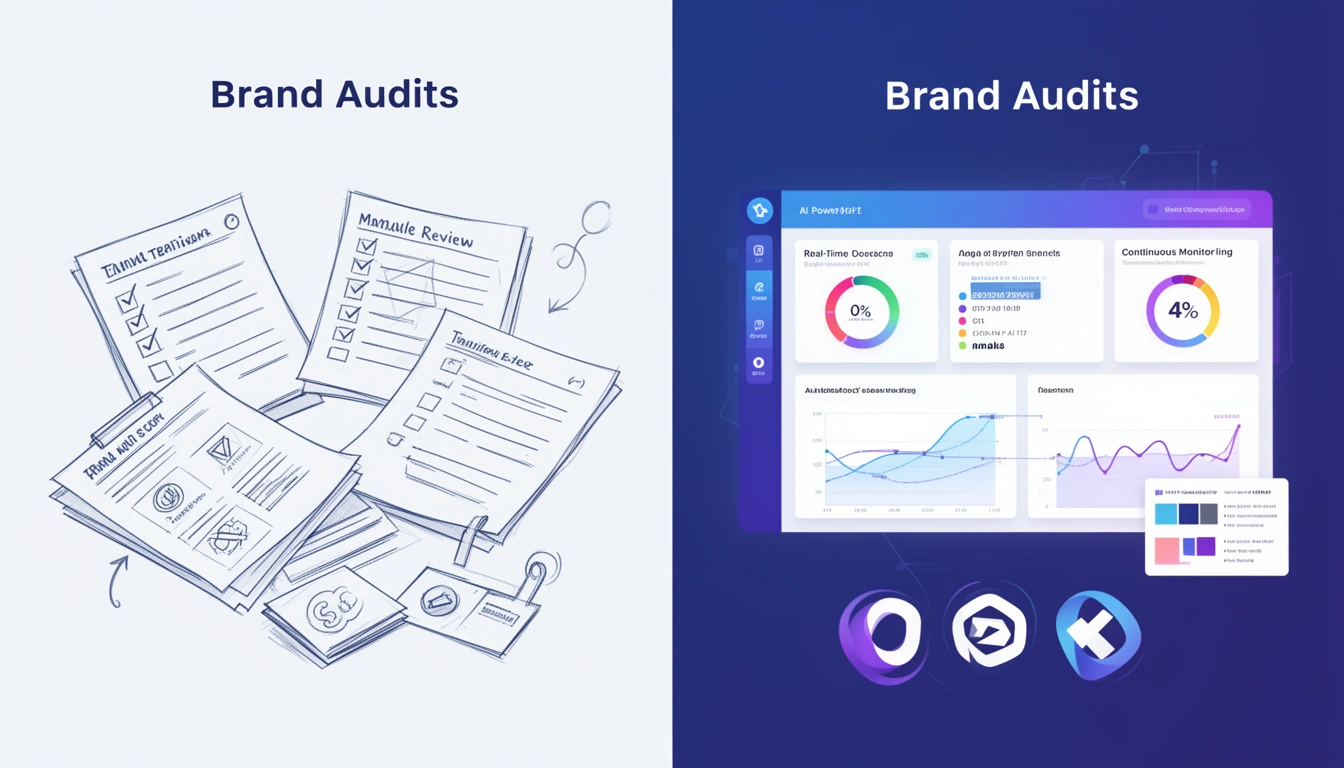
Manual audits can't match AI content velocity. Forward-thinking brands have adopted automated brand compliance that audits continuously:
Real-Time Asset Scanning
AI-powered platforms analyze every asset as it's created:
- Visual compliance: Automated checks verify logo placement, color accuracy, typography, and spacing against brand rules
- Tone analysis: NLP models assess whether copy matches approved brand voice across formal, casual, technical contexts
- Template validation: Systems confirm assets use approved templates without unauthorized modifications
Brand proofing software now catches violations before assets reach customers, transforming audits from retrospective reports to preventive systems.
Compliance Dashboards
Modern brand management platforms provide live audit visibility:
- Compliance scores by department, channel, asset type
- Trend analysis showing improvement or degradation
- Violation heatmaps identifying problem areas
- Automated alerts when compliance drops below thresholds
Generative AI Governance
The most advanced systems audit AI-generated content specifically:
- Brand kit APIs that feed approved assets directly to AI models
- Guardrails preventing off-brand outputs at generation time
- Multi-modal compliance for text, images, video, and voice
- Human-in-the-loop review for high-stakes content
This approach, detailed in our guide on preventing AI slop, ensures brand consistency without sacrificing AI's speed advantages.
Conducting Your 2026 Brand Audit: A Hybrid Approach
The optimal strategy combines automated continuous monitoring with periodic strategic reviews:
Implement Continuous Automated Auditing
Deploy brand compliance automation:
- Implement platforms that scan assets in real-time
- Set up automated alerts for violations
- Create compliance dashboards for visibility
- Integrate with creative tools for pre-publication checking
Establish governance workflows:
- Define approval processes for different content types
- Set compliance thresholds by channel and asset category
- Create escalation procedures for violations
- Document exception request processes
Schedule Quarterly Strategic Reviews
Automated systems handle tactical compliance; humans should focus on strategic questions:
- Brand positioning relevance: Does your brand promise still resonate with target audiences?
- Competitive differentiation: Are competitors eroding your distinctive position?
- Visual identity freshness: Does your brand feel contemporary or dated?
- Messaging effectiveness: Are brand messages driving desired behaviors?
- Market expansion readiness: Can your brand scale to new segments or geographies?
Annual Comprehensive Audits
Once yearly, conduct deep dives that automated systems can't fully address:
- Customer perception research (surveys, focus groups, interviews)
- Competitive brand positioning analysis
- Internal stakeholder alignment assessment
- Brand equity measurement
- Long-term strategic recommendations
Key Metrics for Brand Audit Success
Effective brand audits measure both compliance and business impact:
Compliance Metrics
- Asset compliance rate: Percentage of assets meeting all brand guidelines
- Violation frequency: Number of brand guideline breaches per 1,000 assets
- Time-to-compliance: How quickly violations get corrected
- Channel consistency score: Brand adherence across different platforms
Business Impact Metrics
- Brand recognition: Aided and unaided awareness scores
- Brand perception: Sentiment analysis and attribute association
- Preference and consideration: Share of voice in target segments
- Customer loyalty: NPS, retention, and advocacy metrics
- Marketing efficiency: Cost per acquisition and conversion rates
Operational Metrics
- Review cycle time: Hours spent on manual brand compliance checking
- Rework rate: Percentage of assets requiring brand-related revisions
- Asset findability: Time to locate approved brand materials
- Guidelines accessibility: Usage rates of brand documentation
Common Brand Audit Findings in 2026
Based on industry trends, most brand audits reveal similar patterns:
1. Logo Chaos
Teams use outdated logo versions, incorrect color modes, or improper sizing. Across audited companies, 40-60% of logo usage violates guidelines.
2. Color Drift
Brand colors shift as teams eyeball colors instead of using specified values. RGB/CMYK/HEX inconsistencies create subtle variations that erode recognition.
3. Typography Anarchy
Unauthorized fonts proliferate when approved typefaces aren't easily accessible. Font substitution weakens visual identity.
4. Tone Inconsistency
Brand voice varies wildly between departments, especially as AI-generated content introduces new variations. Marketing sounds different from sales, product, and support.
5. Template Proliferation
Teams create custom templates rather than using approved versions, spawning hundreds of inconsistent variations. This challenge is why enterprise marketing platforms now prioritize template governance.
6. AI-Generated Inconsistency
Content created with ChatGPT, Midjourney, or other generative AI tools often bypasses brand guidelines entirely, creating on-brand-adjacent materials that slowly dilute identity.
7. Decentralized Asset Storage
Brand assets scattered across drives, folders, and tools make compliance nearly impossible. Teams can't find approved materials, so they create their own.
Turning Audit Findings into Action
A brand audit's value lies in implementation. Prioritize fixes using this framework:
Immediate Fixes (Week 1-2)
- Remove egregiously off-brand public-facing materials
- Correct major logo or messaging violations
- Update most-used templates with brand corrections
Short-Term Improvements (Month 1-3)
- Centralize brand assets in accessible repository
- Update and simplify brand guidelines
- Implement automated brand compliance checking
- Train teams on proper brand usage
Long-Term Transformation (Quarter 2-4)
- Deploy comprehensive brand management platform
- Integrate brand governance into creative workflows
- Implement AI-native brand compliance for generative content
- Establish continuous monitoring and quarterly reviews
- Build brand compliance into performance metrics
Brand Kit OS: From Audit to Automated Governance
Traditional brand audits identify problems but don't prevent recurrence. Brand Kit OS transforms brand audits from periodic reports into continuous governance systems.
Our AI-native platform:
- Audits automatically: Every asset gets checked against brand guidelines in real-time, not quarterly
- Prevents violations: Catches off-brand content before publication, not after damage is done
- Scales with AI: Governs AI-generated content at the velocity modern brands require
- Provides visibility: Compliance dashboards show exactly where your brand stands, always
- Enforces consistency: Brand kit APIs feed approved assets directly to creative tools and AI models
Instead of asking "How consistent was our brand last quarter?" you'll know "Is this asset on-brand right now?" before it reaches customers.
Conclusion: From Periodic Checkups to Continuous Health
A brand audit remains essential for understanding your brand's health, but the audit methodology must evolve for the AI era. Manual annual reviews can't keep pace with brands producing hundreds of assets weekly across dozens of channels.
The future belongs to hybrid approaches: automated systems handling continuous tactical compliance while humans focus on strategic brand positioning, competitive differentiation, and long-term evolution.
By implementing automated brand governance, you transform audits from retrospective reports into proactive systems that maintain brand consistency at AI velocity. Your brand becomes audit-ready always, not just when consultants arrive.
Ready to move beyond periodic brand audits to continuous brand governance? Explore how Brand Kit OS automates brand compliance, ensuring every asset human or AI-generated strengthens rather than dilutes your brand identity.