Brand Compliance Marketing Software in 2026
Marketing teams today face an unprecedented challenge: producing more content, faster, across more channels while maintaining perfect brand consistency. With AI-generated content accelerating production velocity by 300-500%, manual brand reviews have become the bottleneck strangling growth.
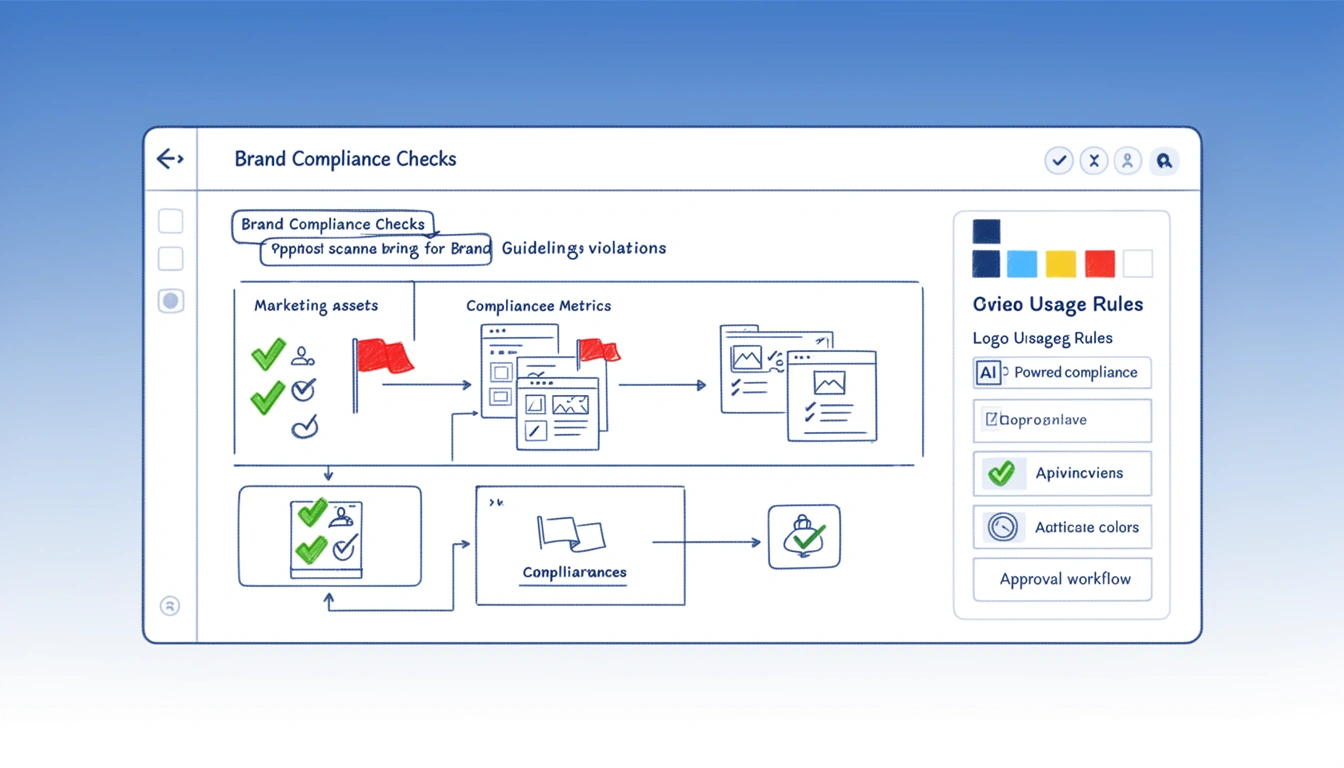
Brand compliance marketing software solves this crisis by automating the enforcement of brand guidelines across every marketing asset, from social posts to landing pages. Instead of hoping marketers remember the rules or bottlenecking creative teams with endless review cycles, these platforms embed brand governance directly into marketing workflows.
What Is Brand Compliance Marketing Software?
Brand compliance marketing software is a category of platforms that automatically validate marketing assets against brand guidelines before publication. Unlike traditional Digital Asset Management (DAM) systems that simply store files, compliance software actively enforces brand rules flagging off-brand colors, incorrect logo usage, tone violations, and formatting errors in real-time.
These platforms transform static brand guidelines into executable systems that integrate with marketing technology stacks, catching compliance issues at the point of creation rather than after costly publication mistakes.
Core Capabilities of Modern Compliance Platforms
Automated Asset Validation: AI-powered engines scan visual and verbal content against defined brand parameters color codes, typography, logo specifications, spacing rules, and tone guidelines. This happens in seconds, not days of human review.
Real-Time Compliance Checking: As marketers create content in tools like Canva, Adobe Creative Cloud, or generative AI platforms, compliance software provides instant feedback. A designer using the wrong shade of brand blue gets flagged immediately, not after printing 10,000 brochures.
Workflow Integration: The best platforms connect directly to marketing tools CMS platforms, social media schedulers, email marketing software, and design applications. This creates compliance checkpoints at every stage of the content lifecycle.
Governance for AI-Generated Content: With marketing teams increasingly using ChatGPT, Midjourney, and other generative AI tools, compliance software ensures AI outputs match brand voice, visual style, and messaging frameworks. This is critical for preventing the "AI slop" problem of generic, off-brand content flooding channels.
Why Marketing Teams Need Compliance Automation in 2026
The marketing landscape has fundamentally shifted. Three converging trends make manual brand compliance impossible:
Content Volume Explosion: Teams produce 5-10x more assets than in 2023, driven by personalization demands, multi-channel strategies, and AI acceleration. A single campaign might generate hundreds of variations across platforms, languages, and audience segments.
Distributed Creation: Marketing content no longer comes from centralized creative teams. Sales creates LinkedIn posts, customer success makes help videos, regional offices adapt campaigns, and partners develop co-branded materials. Every touchpoint becomes a brand risk.
AI Content Velocity: Generative AI enables anyone to produce professional-looking content in minutes. Without automated guardrails, this democratization creates chaos inconsistent messaging, visual fragmentation, and diluted brand equity across thousands of AI-generated assets.
Manual review processes can't scale to meet this reality. By the time a brand manager reviews an asset, ten more have been created. Automated brand compliance becomes the only viable path to maintaining quality at modern marketing velocity.
Key Features to Evaluate in Compliance Software
Multi-Modal Compliance Checking
Modern marketing spans images, videos, text, audio, and interactive experiences. Your compliance software must validate all content types:
- Visual compliance: Logo usage, color accuracy, typography, layout grids, image treatments, and spacing rules
- Verbal compliance: Tone and voice consistency, messaging hierarchy, approved terminology, claim substantiation, and legal disclaimers
- Video compliance: Intro/outro sequences, lower-thirds, color grading, voiceover tone, music selection, and pacing
- Audio compliance: Voice characteristics, background music guidelines, sound effect standards, and podcast formats
AI-Native Architecture
As discussed in our guide on preventing AI slop, the platform should treat your brand kit as an API that generative AI can query. This enables:
- Real-time compliance scoring as AI generates content
- Automated suggestions to bring off-brand outputs into alignment
- Integration with tools like Claude, GPT-4, and Midjourney to guide generation toward compliant outputs
- Fine-tuning capabilities that teach AI models your specific brand patterns
Legacy compliance tools built for human-only workflows fail catastrophically when AI enters the production pipeline.
Intelligent Exception Handling
Not every brand guideline violation is equal. Sophisticated compliance software distinguishes between:
- Critical errors: Wrong logo versions, off-brand colors, legal claim issues hard stops that prevent publication
- Warning-level issues: Suboptimal typography, spacing concerns, tone flags reviewable but not blocking
- Context-dependent rules: Guidelines that vary by channel, region, or campaign type
The platform should support approval workflows for intentional exceptions while maintaining an audit trail of why brand rules were overridden.
Cross-Channel Consistency Enforcement
Your brand appears differently across platforms Instagram demands square formats, LinkedIn prefers long-form, TikTok requires vertical video but the underlying brand identity must remain consistent. Compliance software should understand how brand elements adapt across contexts without fragmenting.
This cross-channel brand consistency capability ensures your Instagram presence feels coherent with your website, email campaigns, and sales materials despite format differences.
Implementation Strategy for Marketing Teams
Phase 1: Codify Your Brand Guidelines
Compliance software only works when brand rules are structured as executable parameters, not vague PDF guidelines. Translate subjective statements like "use vibrant, energetic colors" into specific values:
- Primary brand colors: #FF6B35, #004E89, #F7F7F2 (with acceptable tolerance ranges)
- Typography hierarchy: Headings in Montserrat Bold 32-48pt, body in Open Sans Regular 16-18pt
- Logo clearspace: Minimum 20% of logo height on all sides
- Tone parameters: Confident but approachable, conversational but professional, avoid jargon (with example phrases)
This transformation from static guidelines to centralized brand parameters is the foundation of automation.
Phase 2: Integrate with Marketing Stack
Connect compliance software to where content is created and distributed:
- CMS platforms (WordPress, Contentful, Webflow) for website content validation
- Social media management tools (Hootsuite, Buffer, Sprout Social) for pre-publication checks
- Email platforms (HubSpot, Mailchimp, Marketo) for template and campaign compliance
- Design tools (Figma, Canva, Adobe Creative Cloud) for real-time creation feedback
- AI platforms (ChatGPT, Claude, Midjourney) for generative content governance
Each integration creates an automated checkpoint that reduces manual review burden.
Phase 3: Train Teams on Compliance Workflows
Technology alone doesn't ensure compliance teams must understand how to use feedback loops effectively:
- What different error levels mean and when to escalate
- How to request exceptions for intentional guideline deviations
- Where to find compliance scores and improvement recommendations
- How AI-generated content flows through additional review gates
The goal is making compliance invisible built into workflows rather than added as bureaucratic overhead.
Phase 4: Monitor and Optimize
Use compliance analytics to identify patterns:
- Which guidelines are most frequently violated (indicating training needs or overly restrictive rules)
- Which teams or channels have highest compliance rates (to share best practices)
- How compliance scores correlate with campaign performance (brand consistency often drives engagement)
- Where manual review bottlenecks still exist (to guide further automation)
Brand Kit OS: AI-Native Compliance for Modern Marketing
Brand Kit OS differentiates in this space through its AI-first architecture. Rather than retrofitting brand rules onto platforms built for file storage, it treats your brand kit as a programmatic API that both humans and AI can query for real-time compliance.
Key advantages for marketing teams:
Generative AI Governance: Direct integration with Claude, GPT-4, and other models means AI-generated content is compliant at creation, not flagged after the fact. Your brand parameters guide the generation process itself.
Multi-Modal Asset Support: Validate images, videos, documents, and voice content through unified workflows. A campaign spanning Instagram Reels, LinkedIn articles, and podcast ads gets consistent compliance checking.
Living Brand Guidelines: Instead of static PDFs, guidelines update in real-time and propagate instantly to all integrated tools. When brand colors evolve, every connected platform reflects changes immediately.
Automated Synchronization: Brand assets sync across your marketing stack automatically no manual uploads to multiple platforms. Update your logo once, and it refreshes everywhere it appears.
Compliance Scoring: Every asset receives a compliance score with specific improvement recommendations. Teams see exactly what to fix and why it matters for brand consistency.
This approach scales brand governance to match AI-accelerated content velocity, ensuring quality doesn't sacrifice speed.
ROI of Compliance Automation
The business case for brand compliance marketing software centers on three value drivers:
Risk Mitigation: Off-brand content damages brand equity subtly but cumulatively. A single viral post with wrong logo usage can require months of remediation. Compliance software prevents these reputation risks before they materialize, with quantifiable value in reduced crisis management costs.
Efficiency Gains: Manual review cycles consume expensive senior marketer time that could drive strategy. Automating compliance checking typically reduces review time by 70-85%, freeing brand managers for higher-value work. For a team reviewing 500 assets monthly, this translates to 60-80 hours reclaimed.
Quality Consistency: Automated compliance is more reliable than human review, which varies by reviewer mood, expertise, and time pressure. This consistency improves brand recognition, which drives measurable increases in campaign performance typically 15-30% lifts in engagement when brand consistency improves significantly.
Organizations typically see positive ROI within 3-6 months of implementation as efficiency gains compound.
The Future of Marketing Compliance
As we move deeper into 2026, several trends will reshape brand compliance software:
Predictive Compliance: AI will anticipate brand guideline violations before they occur, suggesting compliant alternatives as marketers work. Imagine typing a headline and seeing real-time tone compliance scores with alternative phrasings that better match brand voice.
Sentiment-Aware Validation: Beyond checking colors and fonts, future compliance tools will validate emotional resonance ensuring content evokes the intended brand feelings, not just technical correctness.
Competitive Differentiation Scoring: Platforms will analyze competitor content to ensure your brand assets are distinctly recognizable, not just internally consistent. This addresses the homogenization risk where all brands start looking similar.
Multi-Brand Intelligence: For organizations managing portfolios of brands, compliance software will navigate complex brand architectures understanding when sub-brands should align with parent brands versus differentiate, and enforcing appropriate separation or connection.
The trajectory is clear: brand compliance shifts from reactive checking to proactive guidance, embedded invisibly in marketing workflows.
Choosing the Right Compliance Platform
When evaluating brand compliance marketing software, prioritize:
- AI-native architecture that governs generative content, not just human-created assets
- Integration breadth with your existing marketing technology stack
- Multi-modal support for all content types your marketing produces
- Scalability to handle increasing content volumes without performance degradation
- Intelligent exception handling that balances governance with creative flexibility
- Analytics depth for continuous compliance optimization
The right platform becomes invisible infrastructure ensuring brand consistency without slowing marketing velocity.
In an era where AI enables anyone to create professional content in minutes, automated brand compliance is the only sustainable path to protecting brand equity at scale. The question isn't whether to implement compliance software, but how quickly you can deploy it before inconsistency fragments your brand across thousands of uncontrolled touchpoints.