Master AI Persona Management for Brand Consistency
If you manage AI for an agency, you've felt this specific kind of panic. You open ChatGPT or Claude, start writing for Client A, and suddenly realize you're using Client B's tone. Brand voices blur. Compliance slips. You spend the first ten minutes of every session re-explaining who the client is. AI persona management is just a way to stop doing that. Brand Kit OS treats a client's voice as something you can actually configure and export, rather than a vibe you have to recreate every time.
The copy-paste style guide workflow is dead. When you're producing AI content at scale for ten or fifty brands, you can't rely on pasting a PDF into a chat thread and hoping the model remembers. You need a system that already knows the client, knows how they sound, and maybe most importantly knows what they'd never say.
What is AI persona management?
It's just saving a specific AI behavior for each brand. Instead of re-explaining a brand's voice every time you prompt, you save a configuration that encodes the tone, the vocabulary, the taboo topics, and the audience. Activate the persona, get consistent output.
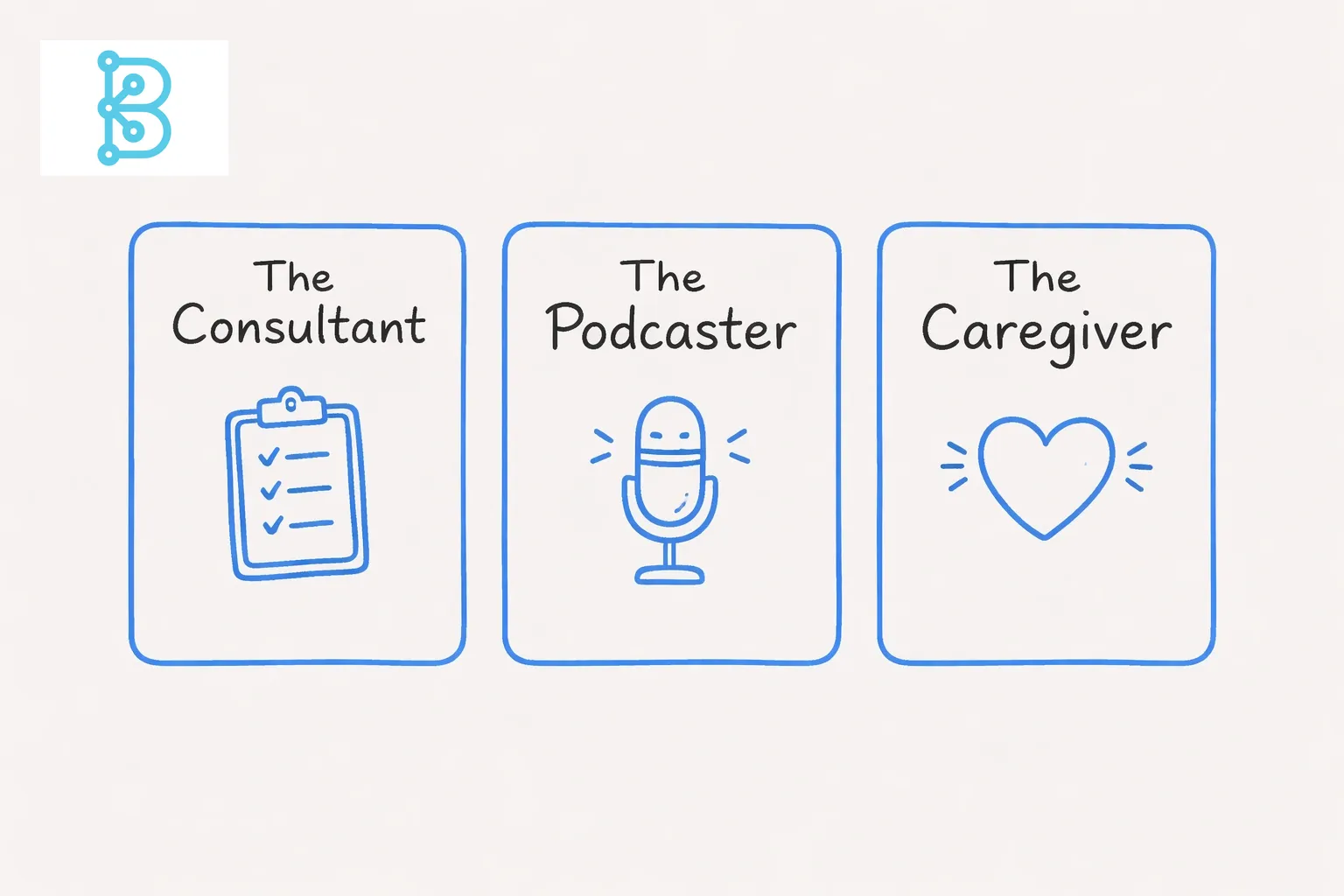
Think of it like a costume closet. One client needs "The Consultant" strict, strategic, structured. Another needs "The Podcaster" casual, energetic, hook-heavy. A wellness brand might need "The Caregiver" tone, leaning empathetic and nurturing.
Without this, agencies rely on memory and copy-paste. Which is a fragile setup. A junior writer forgets the client's "never mention discounts" rule, and suddenly a Claude-generated social post violates brand policy. Encoding the rules once removes that risk.
Brand Kit OS documentation on AI Personas puts it simply: personas are specialized configurations that define how an AI assistant should behave for specific use cases, whether that's support, social, writing, or technical advisory.
Why generic prompting fails for agencies
Generic prompting treats every brand conversation as a one-off. There's no memory of voice rules, no enforcement, and no audit trail. Agencies rebuild the same context dozens of times a week, which wastes hours and invites drift.
Here's what actually goes wrong:
- Voice bleed: Client A's playful tone leaks into Client B's formal copy. Usually happens because someone switched tabs without resetting the context.
- Forgotten taboos: A pharma client's "never mention off-label uses" rule gets ignored in a rushed Slack request at 5 PM on a Friday.
- Cross-tool inconsistency: The brand sounds one way in Claude, another in a generic chatbot, and totally different in a template tool.
- Onboarding friction: New hires spend weeks absorbing tribal knowledge about "how each client talks" instead of just looking at a system.
This fragmentation is exactly what Brand Kit OS was built to fix. The platform's approach to AI Governance for Brand Consistency Across Channels treats brand voice as an enforceable system, not a memory exercise.
How archetypes structure client voices
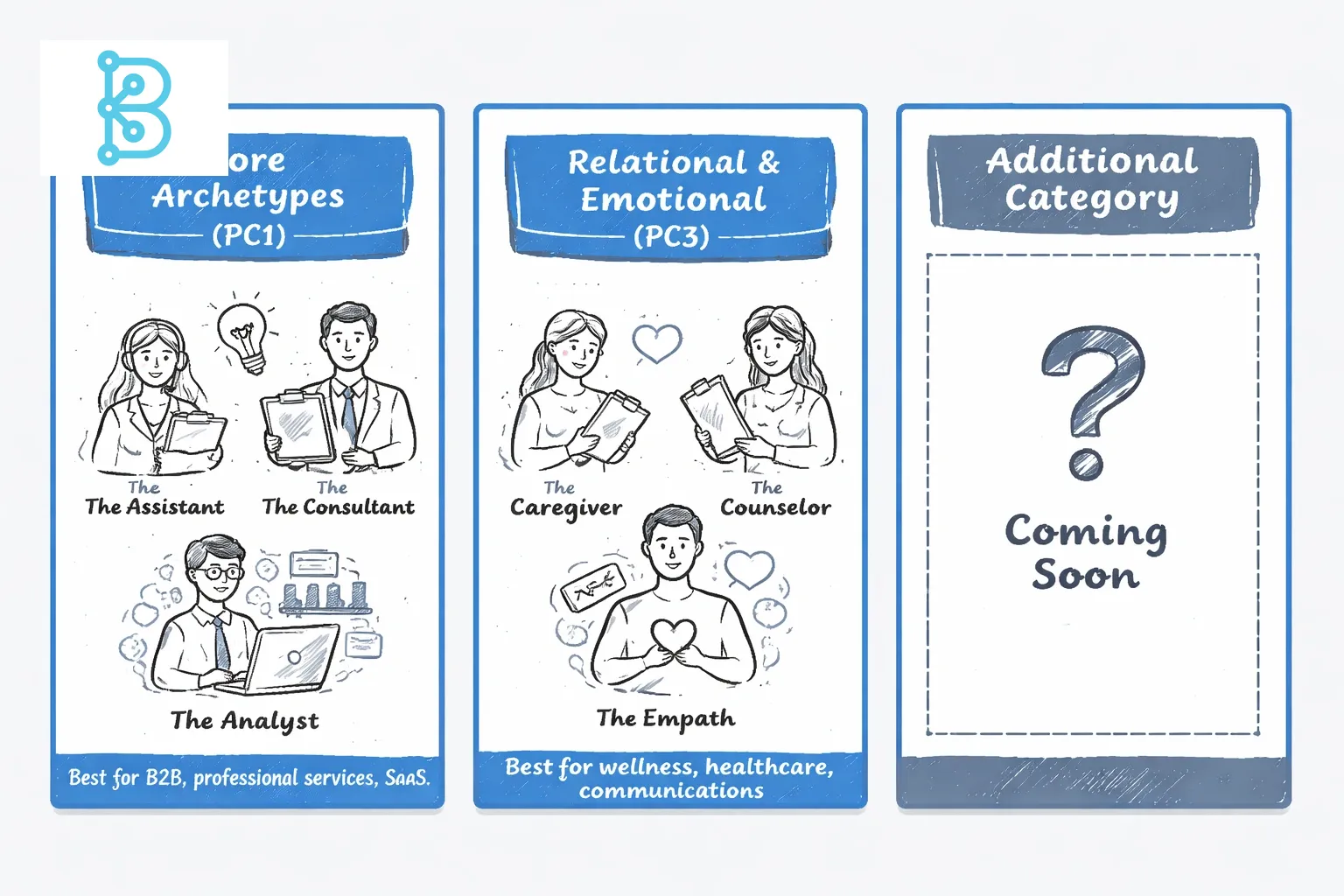
Persona archetypes group traits into research-backed categories so you aren't just guessing. Brand Kit OS's Persona & Archetype Reference Guide pulls from LLM activation-space research across models like Llama, Qwen, and Gemma to define persona types that actually stay stable.
These aren't random. They're organized by category, each representing a different axis of voice:
| Category | Examples | Best For |
|---|---|---|
| Core Archetypes (PC1) | The Assistant, The Consultant, The Analyst | B2B, professional services, SaaS |
| Relational & Emotional (PC3) | The Caregiver, The Counselor, The Empath | Wellness, healthcare, community |
| Conversational & Cultural | The Podcaster, The Ambassador, The Amateur | Consumer, lifestyle, youth-facing |
| Functional | The Summarizer, The Reviewer, The Evaluator | Internal tools, reporting, QA |
Mapping a client to a documented archetype gives your team a shared vocabulary. Instead of a vague brief saying "make it sound friendlier," you can say "shift from The Consultant to The Ambassador for this campaign." That's an instruction people can actually follow.
Building personas without the chaos
You need a single source of truth per client. Each brand kit should have its own persona configuration, completely separate from every other client, but accessible from the same dashboard. That separation is what prevents voice bleed at scale.
A practical setup looks like this:
- Centralize each client's brand kit. Follow a structure similar to Centralized Brand Guidelines: Build a Single Source so tone, values, and constraints live in one place, not scattered across docs and Slack threads.
- Assign a primary persona and backups. Most clients need one dominant voice, but you can pre-build campaign-specific personas (a launch, a crisis response, a seasonal promo) and store them for quick activation.
- Define the "never say" list explicitly. Every persona needs taboo topics documented, not implied. This is where most compliance failures happen.
- Export to the tools your team actually uses. Personas should travel with you into Claude, ChatGPT, or whatever tool a client's campaign requires.
This is the philosophy behind Claude Skill Export: Turn Brand Guidelines Into AI. Static guidelines should become portable, machine-readable instructions, not PDFs nobody reads.
Exporting personas without losing the tone
You can't just screenshot a brand book and paste it into an AI tool. Exporting personas requires structured, portable formats. Brand Kit OS generates custom instructions that carry tone descriptors, do/don't phrases, audience pain points, and CTA preferences directly into the target platform's native format.
An export payload usually looks like this:
- TONE: Writing style descriptors pulled straight from the brand kit
- DO SAY / DON'T SAY: Explicit phrase lists, not vague adjectives
- AUDIENCE: Named personas with documented pain points
- NEVER MENTION: Taboo topics enforced automatically
- INCLUDE CTA: Primary call-to-action baked into every output
This approach ties into the platform's broader MCP Connect with Claude: AI-Powered Brand Intelligence capability, where brand context becomes queryable rather than static. If you're managing ten clients across ten Claude workspaces, you don't need to manually re-brief each session. The persona travels with the connection.
The MCP documentation covers the technical handshake, but the practical benefit is simple: fewer onboarding steps per session, fewer voice mistakes per client.
Who actually needs this?
Multi-client persona management matters most for teams juggling several distinct brand voices at the same time. Agencies, consultants, and growth teams working across multiple accounts face the highest risk of voice bleed and stand to gain the most from getting persona structure right.
Specific groups that benefit immediately:
- Agencies managing dozens of client accounts, where a misplaced tone risks the relationship. See how this plays out for agencies specifically.
- Independent consultants juggling several client voices without a dedicated production team, detailed in the consultants use case.
- Growth teams running rapid experimentation across channels who still need every variant on-brand, as covered in growth teams.
The underlying pain is the same for all of them: too many voices, too little time, and zero tolerance for off-brand slip-ups.
Personas aren't a free pass for governance
Even with well-defined personas, you still need governance. A persona tells the AI how to sound, but it won't automatically catch every compliance issue. Logo misuse, color drift, or factual hallucinations still need a human review layer.
Persona management and brand governance work together. A well-built persona reduces the volume of off-brand output. Automated compliance checks, like those described in Automated Brand Compliance: Scale Quality at Speed, catch what slips through anyway.
AI-generated content moves fast. Teams producing dozens of assets a week can't manually review every single one. Pairing persona-driven voice consistency with automated compliance scanning covers both halves of the risk: how something sounds, and whether it follows the rules.
If you aren't sure where to start, the Brand Audit guide is a useful first step before layering personas on top of a messy brand foundation.
Getting started this quarter
Don't try to rebuild your entire brand system overnight. Start with your highest-risk client the one where a voice mistake would cause the most damage and build a single, documented persona for them.
From there, expand:
- Document one persona per client, starting with your top three accounts by revenue or risk.
- Export that persona to the AI tool your team uses daily.
- Track how much time it saves versus manual re-briefing.
- Add archetype-based backups for campaign-specific tone shifts.
- Layer in automated compliance checks once personas are stable.
Teams that treat this as a quarter-long rollout, rather than a one-week sprint, tend to see better adoption. Reference the features page for a full breakdown of what's configurable per persona, and check pricing to see which plan fits your client roster size.
You can't fake knowing a brand's voice forever, especially when you're churning out fifty assets a week. Brand Kit OS just makes it so you don't have to rely on memory to get it right.