Template Brand Compliance Tools: Enforce Standards 2026
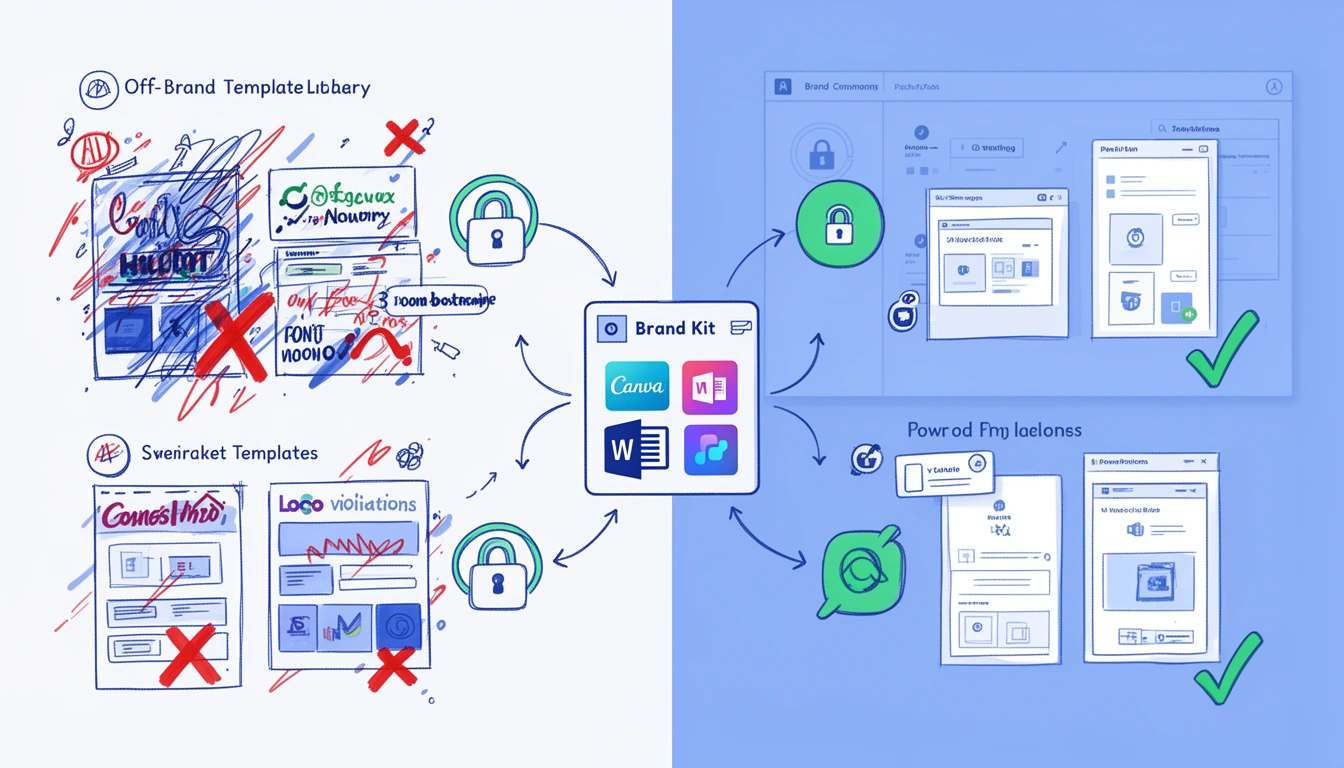
Editable templates are powerful tools for scaling brand content until someone changes the wrong color, swaps in an off-brand logo, or rewrites copy in a tone that doesn't match your voice. For growing teams using Canva, Google Slides, Figma, or PowerPoint, maintaining brand compliance in editable templates is one of the hardest governance challenges in 2026.
This guide explores practical tools and strategies for enforcing brand compliance in editable templates, helping marketing teams, agencies, and enterprises prevent brand drift while empowering creative flexibility.
Why Editable Templates Break Brand Compliance
Editable templates exist to democratize content creation letting sales teams customize pitch decks, regional marketers localize campaigns, and HR create onboarding materials without design resources. But that same flexibility introduces risk:
Color overrides: Users replace brand colors with personal preferences or approximate hex codes
Font substitutions: Missing brand fonts default to system alternatives like Arial or Times New Roman
Logo misuse: Outdated versions, wrong file formats, or improper clear space violations
Tone inconsistency: Copy deviates from approved messaging frameworks or brand voice
Layout chaos: Users delete placeholder elements, break grids, or add unapproved graphics
Without enforcement mechanisms, every edit is a potential brand violation. Manual review processes don't scale when you're producing hundreds of assets weekly across departments and geographies.
Template Compliance Enforcement: The Technology Stack
Modern brand compliance for editable templates requires a combination of design constraints, automation, and AI-powered validation. Here are the essential tool categories:
1. Template Locking and Protection Tools
The first line of defense is restricting what users can edit:
Canva Brand Templates: Lock brand colors, fonts, and logos while allowing text and image customization
Figma Design Systems: Create component libraries with overrides disabled for brand-critical elements
PowerPoint Master Slides: Lock master layouts to prevent accidental deletion of brand elements
Google Slides Template Protection: Protect ranges and elements to restrict editing permissions
Limitation: These native protections only work within their ecosystems and can be bypassed by copying content to new files.
2. Brand Asset Management with Template Distribution
Centralized platforms ensure users always access current, approved templates:
Brandfolder, Bynder, Frontify: Digital asset management (DAM) systems with template libraries and download tracking
Templafy: Enforces compliant templates in Microsoft Office and Google Workspace with server-side validation
Lucidpress (Marq): Brand templating platform with locked elements and approval workflows
Best practice: Version control ensures outdated templates are automatically deprecated, preventing use of old brand guidelines.
3. AI-Powered Brand Compliance Automation
As discussed in our Brand Compliance Guide: Automate Consistency in 2026, AI can validate template outputs in real-time:
Automated color checking: AI scans finished designs and flags hex codes outside approved palettes
Logo detection: Computer vision identifies logo usage violations (wrong version, insufficient padding, color modifications)
Typography validation: Optical character recognition (OCR) verifies approved font usage
Tone analysis: Natural language processing compares copy against brand voice guidelines
Layout compliance: AI models trained on approved designs flag composition deviations
Brand Kit OS takes this further by treating your brand kit as an API automatically syncing compliance rules across template platforms and flagging violations before content goes live.
4. Pre-Flight and Proofing Software
Before templates reach audiences, automated proofing catches compliance issues:
Ziflow, Filestage, Aproove: Collaborative proofing with custom brand checklists and automated validation rules
Bannerflow, Celtra: Creative management platforms with built-in brand compliance for display ads
Brand proofing automation: As covered in Brand Proofing Software: Automate Compliance in 2026, AI-driven tools can validate thousands of template outputs simultaneously
Integration advantage: Connect proofing tools to project management platforms (Asana, Monday.com) to block publication until compliance is verified.
5. Template Analytics and Usage Monitoring
You can't enforce what you can't measure:
Template download tracking: Monitor which templates are most used and identify departments with compliance issues
Edit history logging: Audit trails show who changed what and when
Compliance scoring: Dashboard metrics tracking brand adherence rates across teams
Violation alerts: Automated notifications when critical brand elements are modified
For enterprises managing multiple brands, these insights are critical see our guide on Enterprise Marketing Platforms: Brand Compliance Reviews for scaling strategies.
Implementation Strategy: Building Template Compliance Workflows
Technology alone won't solve template compliance. Here's a practical implementation framework:
Step 1: Audit Current Template Usage
Identify all template sources (Canva, PowerPoint, Google Slides, Figma, etc.)
Document who creates, edits, and distributes templates
Analyze common compliance violations in current outputs
Map template types to risk levels (customer-facing vs. internal)
Step 2: Define Compliance Rules and Tolerance Levels
Not every edit is a crisis. Establish clear parameters:
Non-negotiable: Primary logo usage, core brand colors, legal disclaimers
Controlled flexibility: Secondary color application, image selection, headline wording
Free editing zones: Body copy customization, data visualization, internal presentation content
Step 3: Select and Configure Enforcement Tools
Choose tools based on your template ecosystem:
Small teams (2-20 people): Native platform protections (Canva Brand Kit, Figma components) + manual spot checks
Mid-size organizations (20-200): Template management platform (Templafy, Marq) + DAM system with versioning
Enterprises (200+): AI-powered compliance automation + integrated proofing workflows + usage analytics
Step 4: Create Fail-Safes and Human Oversight
Automation should assist, not replace, human judgment:
Establish approval workflows for high-risk templates (customer campaigns, legal documents)
Train brand champions within departments to serve as first-line reviewers
Build escalation paths for ambiguous compliance questions
Schedule quarterly template audits to catch systematic drift
Step 5: Educate Users and Provide Alternatives
Compliance tools fail if users circumvent them:
Explain why brand compliance matters (customer trust, legal protection, efficiency)
Offer diverse template options so users don't feel creatively constrained
Create a request process for custom template needs
Celebrate teams with high compliance scores to reinforce positive behavior
Advanced Compliance: AI-Native Template Governance
The next evolution in template compliance is treating templates not as static files but as dynamic, API-driven systems that enforce rules automatically.
Programmatic Templates with Real-Time Validation
Instead of distributing editable files, generate templates on-demand from a central brand kit:
User selects template type and inputs custom content
System pulls current brand assets (logos, colors, fonts) from centralized library
AI validates inputs against compliance rules before rendering
Final output is generated with guaranteed brand adherence
This approach eliminates the possibility of outdated assets or off-brand modifications.
Generative AI Integration for Smart Templates
AI can assist content creation while enforcing compliance:
Copy generation: AI writes headlines and body copy in approved brand voice
Image selection: Computer vision suggests on-brand imagery from asset library
Layout optimization: AI adjusts designs to maintain grid integrity when content length varies
Multi-language adaptation: Automated translation with tone preservation
Brand Kit OS enables this by connecting your brand guidelines directly to generative AI tools, ensuring every AI-assisted template edit stays on-brand.
Measuring Template Compliance Success
Track these KPIs to evaluate your enforcement strategy:
Compliance pass rate: Percentage of template outputs meeting all brand requirements
Time to publication: How enforcement tools affect content velocity
Violation by category: Which rules are most frequently broken (color, logo, copy, etc.)
Department performance: Identify teams needing additional training
Template abandonment rate: If users create from scratch instead of using templates, your system is too restrictive
Support tickets: Frequency of compliance questions indicates unclear guidelines
Common Pitfalls and How to Avoid Them
Over-Locking Templates
Problem: Templates so restrictive they're useless for real-world needs.
Solution: Offer template tiers locked versions for critical uses, flexible versions for internal content.
Tool Fragmentation
Problem: Different compliance systems for Canva, PowerPoint, Figma create gaps.
Solution: Centralize enforcement through a brand management platform that integrates across ecosystems.
Ignoring Mobile and Social Formats
Problem: Focus on presentation templates while social media posts go unchecked.
Solution: Ensure compliance tools cover Instagram Stories, LinkedIn carousels, TikTok videos, etc.
No Consequence for Violations
Problem: Users ignore compliance alerts because there's no follow-through.
Solution: Implement publication blocks for critical violations and include compliance in performance reviews.
The Future of Template Compliance: Context-Aware Automation
Looking ahead, template compliance tools will become more intelligent:
Context-sensitive rules: Different compliance thresholds for internal vs. external, regional vs. global, or campaign vs. evergreen content
Predictive violations: AI warns users before they make non-compliant edits
Automated remediation: Systems auto-correct minor violations (wrong hex code → nearest approved color)
Natural language rule creation: Brand managers define compliance rules in plain English; AI translates to executable code
Choosing the Right Tools for Your Brand
When evaluating template compliance tools, ask:
Integration: Does it work with your existing design platforms (Canva, Adobe, Microsoft, Google)?
Automation depth: Can it validate compliance automatically or only provide manual checklists?
Customization: Can you configure rules specific to your brand guidelines?
Scalability: Will it handle your template volume as your team grows?
User experience: Is compliance enforcement visible and helpful, or invisible and frustrating?
Analytics: Does it provide insights to improve guidelines and training?
For teams using AI for content generation, ensure your compliance tools can govern AI-assisted edits not just human ones. Platforms like Brand Kit OS are purpose-built for this AI-native reality, treating compliance as an automated layer rather than a manual review bottleneck.
Getting Started with Template Compliance Enforcement
If you're just beginning to formalize template governance:
Start with highest-risk templates: Customer-facing sales decks, external presentations, marketing campaigns
Implement one enforcement mechanism: Don't try to deploy every tool at once
Gather user feedback: Compliance systems only work if people use them
Iterate based on violation data: Let analytics guide where to tighten or loosen controls
Communicate wins: Show teams how compliance protects the brand and makes their jobs easier
As you mature, layer in AI-powered automation, expand coverage to more template types, and integrate compliance metrics into broader brand governance dashboards.
Conclusion: From Template Chaos to Compliant Creativity
Editable templates will always carry compliance risk that's the price of democratized content creation. But with the right combination of platform-native protections, centralized asset management, AI-powered validation, and human oversight, you can enforce brand compliance without sacrificing creative velocity.
The goal isn't to eliminate all editing flexibility it's to create guardrails that keep your brand consistent while empowering teams to produce content at scale. In 2026, as AI accelerates content production even further, automated template compliance isn't optional it's the only way to maintain brand integrity across hundreds or thousands of touchpoints.
Ready to automate compliance across your template library? Explore how Brand Kit OS turns your brand guidelines into executable rules that work across every template platform, with AI-powered validation that scales as fast as your content needs.