Brand Proofing Software: Automate Compliance in 2026
In the age of AI-generated content, brand teams are producing more materials than ever but velocity without accuracy creates risk. As marketing teams scale content production in 2026, automated brand proofing software has become essential infrastructure for maintaining consistency, protecting brand equity, and preventing costly errors before they reach customers.
Brand proofing software automates the review process that traditionally required manual checks across every asset, flagging deviations from brand guidelines in real-time. For teams managing high-volume content across multiple channels, this technology transforms brand compliance from a bottleneck into a competitive advantage.
What Is Brand Proofing Software?
Brand proofing software is a specialized tool that automatically validates content against your brand guidelines before publication. Unlike traditional proofreading tools that focus solely on grammar and spelling, brand proofing systems check for:
Visual consistency: Logo usage, color accuracy, typography compliance, and spacing requirements
Messaging alignment: Tone of voice, terminology standards, and messaging framework adherence
Asset governance: Approved image usage, version control, and rights management
Channel-specific rules: Platform requirements, format specifications, and localization standards
Legal compliance: Trademark usage, regulatory disclosures, and copyright protections
Modern proofing platforms integrate AI to learn your brand's unique characteristics, creating automated checkpoints that prevent off-brand content from entering production workflows.
Why Traditional Manual Proofing Fails at Scale
Manual brand reviews worked when marketing teams produced a dozen assets per month. In 2026, that same team might generate hundreds of AI-assisted variations across social media, email, web, and paid channels all requiring brand compliance.
The limitations of manual proofing include:
Human inconsistency: Different reviewers interpret guidelines differently, creating subjective approval patterns
Time constraints: Thorough reviews take 15-30 minutes per asset, creating production delays
Scalability barriers: Hiring more reviewers doesn't solve inconsistency and becomes cost-prohibitive
Error fatigue: Reviewers miss subtle violations when processing high volumes
Knowledge silos: Brand expertise concentrated in a few individuals creates single points of failure
As explored in our Brand Compliance Guide: Automate Consistency in 2026, automated systems solve these challenges by encoding brand rules into software that never tires, never interprets subjectively, and scales infinitely.
Core Features of Modern Brand Proofing Software
1. Visual Brand Analysis
Advanced proofing platforms use computer vision to analyze visual elements against your brand kit:
Color matching within specified tolerances (typically 1-3% variance)
Logo placement validation against clear space requirements
Typography detection for approved font families and sizes
Layout composition checks for grid systems and alignment
Image style consistency using AI-trained brand aesthetics
2. Content & Messaging Validation
Natural language processing capabilities check written content for:
Tone of voice alignment with brand personality
Terminology compliance (approved terms vs. banned phrases)
Messaging framework adherence to positioning statements
Grammar and style consistency with editorial standards
Claim substantiation for regulated industries
3. Asset Rights Management
Proofing systems integrate with digital asset management to verify:
Usage rights and licensing permissions
Asset expiration dates and version currency
Approval workflows and stakeholder sign-offs
Geographic or channel usage restrictions
Model releases and copyright clearances
4. Multi-Channel Compliance
Channel-specific validation ensures content meets platform requirements:
Dimension and file size specifications
Text-to-image ratios for paid social
Accessibility standards (alt text, contrast ratios)
Platform-specific brand adaptations
Localization requirements for global markets
5. AI-Generated Content Governance
With generative AI becoming standard in content workflows, proofing software now includes specialized checks for AI outputs:
Hallucination detection for factual accuracy
Brand voice deviation flagging
Visual coherence for AI-generated imagery
Style transfer validation
Training data attribution for IP protection
Learn more about managing AI-generated content in our guide on How to Prevent AI Slop: Generate On-Brand Content.
The Business Case for Automated Brand Proofing
Quantifiable ROI Metrics
Organizations implementing brand proofing software typically see:
70-85% reduction in review time per asset
40-60% decrease in revision cycles and rework
3-5x increase in content production capacity
90%+ reduction in published brand violations
25-40% improvement in campaign performance from consistency
Risk Mitigation Value
Beyond efficiency gains, automated proofing prevents costly errors:
Regulatory compliance: Avoiding fines for misleading claims or disclosure violations
Brand equity protection: Preventing dilution from inconsistent expression
Legal risk reduction: Catching trademark misuse or copyright infringement
Reputation management: Stopping offensive or inappropriate content
Competitive advantage: Maintaining differentiation in crowded markets
Implementation Strategies for Brand Proofing Systems
Step 1: Codify Your Brand Guidelines
Effective proofing requires machine-readable brand rules:
Convert subjective guidelines into objective specifications
Define acceptable ranges for visual elements (colors, spacing, sizes)
Document tone of voice with specific linguistic patterns
Create decision trees for contextual brand adaptations
Establish priority hierarchies when rules conflict
Brand Kit OS treats brand guidelines as executable APIs, enabling AI systems to interpret and enforce rules programmatically rather than relying on human interpretation.
Step 2: Integrate with Existing Workflows
Proofing software should fit seamlessly into current production processes:
Connect to design tools (Adobe Creative Cloud, Figma, Canva)
Integrate with project management platforms (Asana, Monday, Workfront)
Embed in content management systems (WordPress, Contentful, Sanity)
Link to digital asset management (Bynder, Brandfolder, Widen)
Support API connections for custom MarTech stacks
Step 3: Configure Escalation Protocols
Not all violations require the same response:
Auto-approve: Minor deviations within tolerance ranges
Flag with suggestions: Moderate issues with automated correction options
Block with explanation: Serious violations that prevent publication
Human review required: Edge cases needing expert judgment
Escalate to legal/compliance: Regulatory or IP concerns
Step 4: Train Teams on Proofing Outputs
Technology only succeeds with proper adoption:
Educate creators on interpreting proofing feedback
Provide context for why specific rules exist
Create self-service resources for common violations
Establish feedback loops to refine rules based on real usage
Celebrate compliance wins to reinforce desired behaviors
Brand Proofing vs. Adjacent Technologies
Proofing Software vs. DAM Systems
Digital Asset Management stores and organizes brand assets; proofing software validates their correct usage. The technologies complement each other:
DAM: Centralized repository for approved assets
Proofing: Automated validation that assets are used correctly in context
Integration value: Proofing systems reference DAM as source of truth for approved elements
Proofing Software vs. Style Checkers
Tools like Grammarly focus on grammar and readability; brand proofing adds brand-specific rules:
Style checkers: Generic writing quality and clarity
Brand proofing: Adherence to your unique brand voice, terminology, and positioning
Combined approach: Use both for comprehensive content quality
Proofing Software vs. Compliance Platforms
Regulatory compliance platforms focus on legal requirements; brand proofing adds marketing consistency:
Compliance platforms: Industry regulations, disclosures, claim substantiation
Brand proofing: Visual identity, messaging frameworks, creative standards
Overlap: Both prevent publication of non-compliant content
For teams needing comprehensive solutions, explore our analysis of Brand Compliance Marketing Software in 2026, which examines platforms combining both capabilities.
Selecting the Right Brand Proofing Software
Evaluation Criteria
When assessing proofing platforms, consider:
Detection accuracy: False positive rate and ability to catch subtle violations
Learning capabilities: AI improvement over time with your specific brand
Integration breadth: Compatibility with your existing tool stack
Customization depth: Ability to encode complex, nuanced brand rules
Processing speed: Real-time feedback vs. batch processing delays
User experience: Intuitive interface that creators will actually use
Reporting capabilities: Insights into compliance patterns and violation trends
Scalability: Performance with growing content volumes and team sizes
Questions for Vendors
How does your system handle brand-specific edge cases and exceptions?
What training data do you use, and how do you protect our brand IP?
Can we adjust rule sensitivity based on content type or channel?
How do you stay current with platform changes (social media, advertising specs)?
What human oversight options exist for AI-driven decisions?
How do you measure and report on ROI from your platform?
What onboarding support do you provide for encoding our brand guidelines?
The Future of Brand Proofing: Predictive and Generative
Predictive Brand Performance
Next-generation proofing software won't just catch errors it will predict performance:
Audience resonance scoring: Predicting engagement based on brand expression variations
A/B test recommendations: Suggesting on-brand alternatives to test
Channel optimization: Adapting brand elements for maximum platform performance
Trend alignment: Balancing brand consistency with cultural relevance
Generative Brand Correction
Rather than just flagging violations, AI proofing systems will offer automated fixes:
Auto-correction suggestions: One-click fixes for common violations
Alternative generation: Creating on-brand variations when content fails checks
Style transfer: Automatically adapting off-brand content to compliance
Smart templating: Generating guardrails that prevent violations upfront
Continuous Brand Learning
AI systems will evolve brand guidelines based on performance data:
Identifying which brand expressions drive best results
Recommending guideline updates based on market response
Detecting brand drift before it becomes problematic
Adapting rules for emerging channels and formats
This evolution from static guidelines to dynamic, data-informed brand systems represents the future of Dynamic Brand Guidelines Software.
Common Implementation Challenges and Solutions
Challenge: Resistance from Creative Teams
Concern: Designers fear automation will stifle creativity or override expert judgment.
Solution: Position proofing as creative enablement, not creative limitation. Automated checks handle routine compliance, freeing creatives to focus on strategic and conceptual work. Implement override options with explanation requirements, preserving human agency for justified exceptions.
Challenge: Guidelines Too Subjective to Automate
Concern: Brand standards contain nuance and context that software can't capture.
Solution: Start with objective, measurable rules (colors, logos, layouts) and gradually encode more complex guidelines using AI training on approved examples. Accept that some brand decisions will always require human judgment proofing systems should triage to human experts, not replace them entirely.
Challenge: Integration Complexity
Concern: Connecting proofing software to existing tools creates technical challenges.
Solution: Prioritize platforms with robust API ecosystems and pre-built integrations for common MarTech tools. Consider implementation partners with expertise in your specific stack. Start with high-volume workflows to maximize ROI before expanding integration footprint.
Challenge: Maintaining Rule Currency
Concern: Brand guidelines evolve, and proofing rules become outdated.
Solution: Establish governance processes for rule updates tied to brand guideline revisions. Use version control for brand kits to maintain historical compliance while enabling evolution. Schedule quarterly reviews of flagged violations to identify rules needing refinement.
Brand Proofing for Multi-Brand Organizations
Enterprise organizations managing portfolio brands face unique proofing challenges:
Separate Brand Rules with Shared Infrastructure
Encode distinct guidelines for each brand
Create master brand rules for parent company standards
Define brand relationship hierarchies (endorsed, sub-brands, etc.)
Establish cross-brand usage policies (when brands can co-appear)
Efficiency Through Standardization
Identify common rule patterns across brands
Create reusable rule templates for new brand launches
Centralize proofing infrastructure while customizing parameters
Share learnings and best practices across brand teams
For comprehensive strategies, see our guide on Multi-Brand Management Tool: Scale Brand Consistency.
Implementing Brand Proofing with Brand Kit OS
Brand Kit OS approaches proofing differently than traditional solutions by treating brand guidelines as executable APIs rather than static documents. This architecture enables:
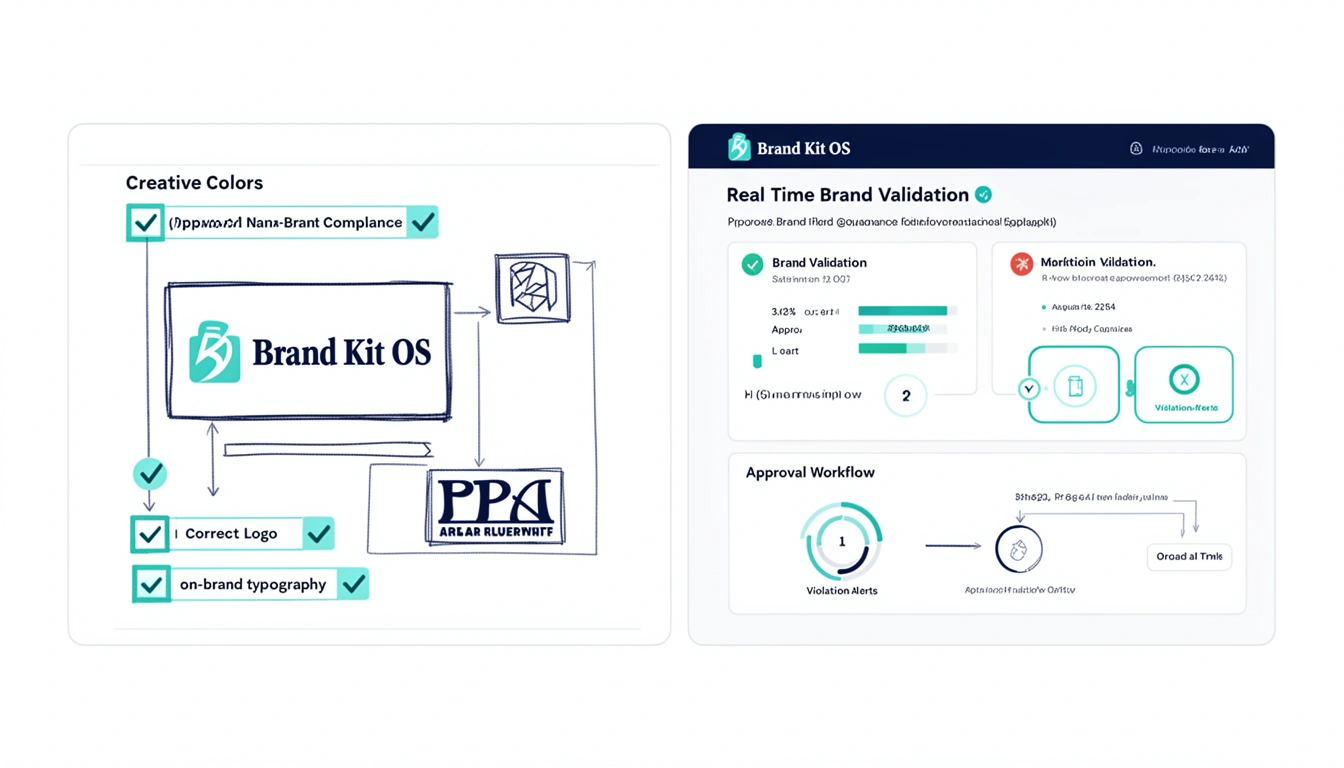
Real-Time Automated Validation
Every asset created or modified triggers automated compliance checks against your brand kit API, flagging violations before content enters review workflows. This shifts brand governance from reactive (catching errors in review) to proactive (preventing errors at creation).
AI-Native Brand Enforcement
Brand Kit OS integrates directly with generative AI workflows, ensuring AI-generated content adheres to brand standards from initial prompt through final output. The platform validates:
Prompt alignment with brand messaging frameworks
Generated copy against tone of voice specifications
Visual outputs for style consistency and logo compliance
Multi-modal content for cross-element coherence
Learning System with Human Oversight
The platform learns from approval patterns and edge case decisions, continuously refining proofing accuracy while maintaining human governance for nuanced judgments. This hybrid approach delivers automation's efficiency with expertise's wisdom.
Centralized Brand Truth
Rather than maintaining separate brand guidelines and proofing rules, Brand Kit OS uses a single source of truth that simultaneously serves as brand reference and enforcement mechanism. Updates to brand standards immediately propagate to all proofing checkpoints.
Measuring Brand Proofing Success
Track these metrics to quantify proofing software impact:
Efficiency Metrics
Average review time per asset: Measure reduction from baseline
Revision cycles before approval: Track decrease in rework
Content production volume: Quantify capacity increase
Time to publish: Measure workflow acceleration
Quality Metrics
Violation detection rate: Percentage of errors caught pre-publication
False positive rate: Incorrect flags that slow workflows
Published error rate: Violations that reach customers
Brand consistency scores: Aggregate compliance across content
Business Impact Metrics
Brand recall and recognition: Customer research on brand perception
Campaign performance: Engagement and conversion rates
Cost per asset: Total production cost including reviews and rework
Risk mitigation value: Estimated cost of prevented violations
Getting Started with Brand Proofing Software
For Small Teams (2-10 People)
Start here: Focus on automating visual brand checks (logos, colors, fonts) where violations are easiest to detect and most visible to customers.
Quick win: Implement proofing for high-volume, template-based content (social media posts, email headers) to demonstrate ROI before expanding.
For Mid-Size Teams (10-100 People)
Start here: Prioritize channels with highest compliance risk or greatest production volume to maximize impact and learnings.
Quick win: Integrate proofing with existing design tools to provide real-time feedback without workflow disruption, increasing adoption.
For Enterprise Teams (100+ People)
Start here: Pilot with one business unit or region to refine rules and processes before global rollout.
Quick win: Deploy proofing for regulated content (financial, healthcare, legal) where compliance requirements create urgency and clear success criteria.
Conclusion: Proofing as Strategic Infrastructure
Brand proofing software has evolved from a nice-to-have efficiency tool to essential infrastructure for modern marketing organizations. As AI accelerates content production and multiplies distribution channels, automated brand validation becomes the only viable path to maintaining consistency at scale.
The question is no longer whether to implement automated proofing, but how quickly you can establish it as a competitive advantage. Teams that encode brand expertise into software systems will scale quality and velocity simultaneously. Those relying on manual reviews will face an impossible choice between speed and brand integrity.
In 2026, your brand proofing strategy directly determines your content capacity, compliance risk, and market differentiation. Choose systems that don't just catch errors but actively enable brand excellence turning governance from a gate into a growth driver.