Brand Asset Management | The Complete Guide for Scaling Modern Businesses
Introduction to Brand Asset Management
Brand Asset Management is no longer a “nice-to-have” for businesses aiming to scale—it’s a necessity. As organizations grow, so does the complexity of managing logos, brand visuals, messaging frameworks, marketing collateral, and digital content. Without a structured system, brand inconsistency creeps in, teams slow down, and brand equity begins to erode.
In simple terms, Brand Asset Management ensures that every brand element is stored, governed, and used correctly across all channels. Many growing businesses now rely on online brand management systems to centralize assets, streamline workflows, and maintain consistency without slowing execution.
As markets become more competitive and digital touchpoints multiply, Brand Asset Management acts as the backbone of sustainable growth. It improves marketing efficiency, protects intellectual property, and reinforces trust with customers at every interaction.
Understanding Brand Assets in Modern Businesses
What Are Brand Assets?
Brand assets are the visual, verbal, and experiential elements that represent a brand. These include logos, color palettes, typography, imagery, videos, templates, tone of voice, messaging frameworks, brand guidelines, and even sound cues or animations.
Each asset plays a role in shaping perception and recall. When used consistently, brand assets build recognition, credibility, and trust. When misused or inconsistently applied, they dilute brand value and confuse audiences.
Brand Asset Management provides structure to these assets, ensuring teams always know what to use, when to use it, and how to use it correctly.
Digital vs Physical Brand Assets
Digital assets dominate modern branding—website visuals, social media creatives, videos, UI elements, email templates, and digital ads all need to stay aligned across platforms. At the same time, physical assets such as packaging, signage, merchandise, and print materials still matter, especially for omnichannel brands.
Brand Asset Management bridges digital and physical branding by creating a centralized system of control. This ensures your brand looks and feels consistent whether it appears on a mobile screen, a billboard, or a product package.
Why Brand Assets Define Brand Equity
Brand equity is built on trust, recognition, and consistency. When customers repeatedly encounter a familiar look and message, confidence grows. Research consistently shows that brands with strong consistency across channels outperform competitors in revenue growth and customer loyalty.
That consistency doesn’t happen accidentally—it’s the result of disciplined Brand Asset Management.
Why Brand Asset Management Is Critical for Scaling Businesses
Consistency Across Teams and Channels
As businesses scale, more people touch the brand. Internal teams expand, agencies get involved, partners create content, and regional markets adapt campaigns. Without a structured Brand Asset Management system, inconsistency becomes inevitable.
Centralized brand control ensures approved logos, colors, and messaging are used everywhere. This strengthens brand recall and builds customer confidence across all touchpoints.
Speed and Go-To-Market Efficiency
Speed is essential when scaling. Marketing teams can’t afford to waste time searching for files, recreating assets, or correcting brand mistakes.
Brand Asset Management removes friction. Teams can instantly access approved, ready-to-use assets. Campaigns launch faster, productivity improves, and costs are reduced—without sacrificing brand quality.
Risk Reduction and Brand Protection
Using outdated logos, incorrect messaging, or unapproved visuals can damage credibility and create legal risks.
Brand Asset Management introduces governance through permissions, approvals, and version control. This protects brand integrity—especially important as the number of stakeholders grows.
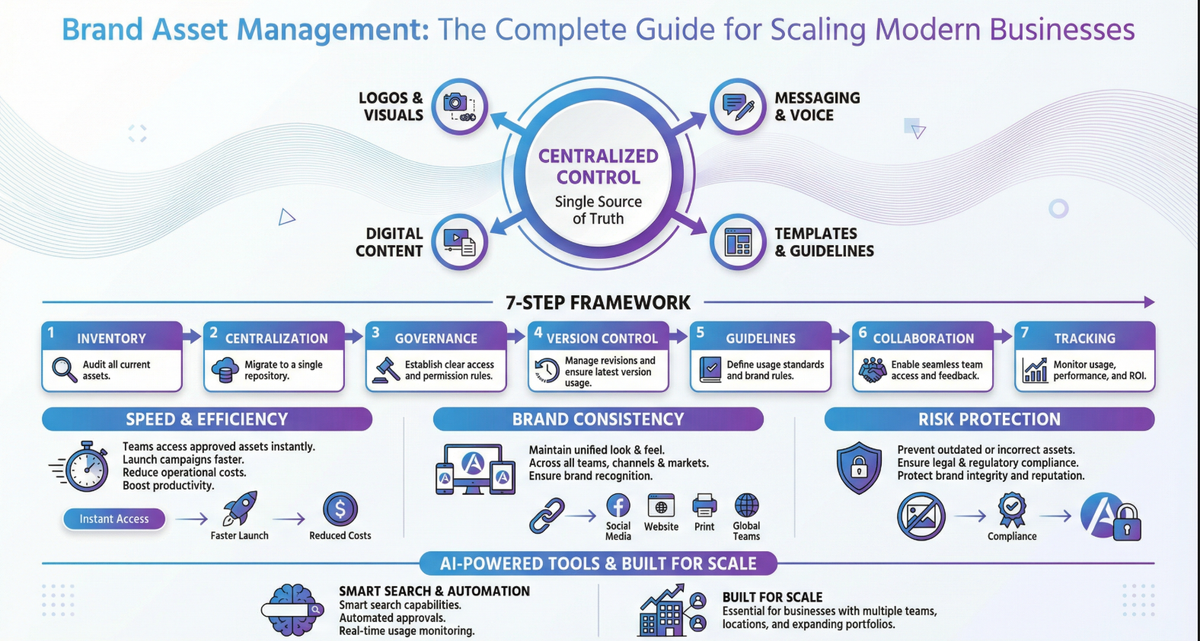
The 7-Step Brand Asset Management Framework
Step 1: Asset Inventory
Begin by identifying all existing brand assets—current, outdated, and unused. An accurate inventory provides clarity and highlights gaps or redundancies.
Step 2: Centralization
Store all assets in one centralized system. Eliminate scattered folders, emails, and duplicated files. Centralization improves accessibility and ensures teams always work from a single source of truth.
Step 3: Governance and Access Control
Define who can view, edit, approve, and distribute brand assets. Governance creates accountability while still allowing teams to move efficiently.
Step 4: Version Control
Version control ensures that only the most up-to-date assets are used. It prevents outdated logos, old messaging, and incorrect designs from appearing in public-facing materials.
Step 5: Brand Guidelines Integration
Integrate brand guidelines directly into your asset system. This helps teams understand not just what to use, but how to use it correctly across different channels and formats.
Step 6: Collaboration Enablement
Enable collaboration with agencies, freelancers, partners, and regional teams. Everyone should work from the same approved assets and guidelines to maintain consistency at scale.
Step 7: Performance Tracking
Track how assets perform across campaigns and channels. Data-driven Brand Asset Management helps refine strategy, improve ROI, and focus resources on high-performing assets.
Role of Technology in Brand Asset Management
Brand Asset Management vs Digital Asset Management
Digital Asset Management (DAM) focuses primarily on file storage and organization. Brand Asset Management goes further by adding brand rules, governance, approvals, and strategic alignment.
Modern businesses increasingly adopt AI Brand Kit Software that combines asset storage with intelligent brand control.
AI and Automation in Brand Management
AI-powered tagging, smart search, automated approvals, and real-time usage monitoring are transforming how brands operate. An AI-powered brand management tool reduces manual effort, minimizes errors, and ensures brand consistency without slowing teams down.
Cloud-Based Brand Systems
Cloud-based platforms allow secure, scalable, and remote access to brand assets. This is especially important for distributed teams, global operations, and fast-growing startups.
Brand Asset Management Best Practices
- Maintain a single source of truth for all brand assets
- Update and audit assets regularly
- Train teams on proper brand usage
- Enforce approval workflows
- Use reliable brand kit software Texas teams can access easily across locations
Consistency isn’t restrictive—it empowers teams to move faster with confidence.
Common Brand Asset Management Mistakes to Avoid
- Storing assets across multiple platforms
- Ignoring governance and approvals
- Allowing unrestricted access
- Failing to document brand guidelines
- Treating Brand Asset Management as a one-time task
Avoiding these mistakes protects long-term brand value and reduces operational friction.
Real-World Use Cases of Brand Asset Management
Fast-growing SaaS companies use Brand Asset Management to align global marketing teams. Retail brands rely on it to maintain consistency across stores and regions. Enterprises depend on it to protect intellectual property and brand integrity at scale.
For early-stage companies, especially in competitive U.S. markets, Texas startup branding tools offer an accessible way to implement professional brand systems without enterprise-level complexity.
Frequently Asked Questions
What is Brand Asset Management?
Brand Asset Management is the process of organizing, governing, and controlling brand assets to ensure consistent usage across all channels.
How does Brand Asset Management support scaling?
It enables faster execution, maintains consistency across teams, reduces risk, and improves efficiency as businesses grow.
Is Brand Asset Management different from Digital Asset Management?
Yes. Brand Asset Management includes brand governance, guidelines, approvals, and strategic alignment beyond simple file storage.
Who needs Brand Asset Management?
Any business with multiple teams, channels, partners, or markets—especially startups and enterprises preparing to scale.
What assets should be included?
Logos, visuals, videos, templates, brand guidelines, messaging frameworks, and marketing collateral.
How often should brand assets be reviewed?
At least quarterly, or whenever significant brand updates occur.
Conclusion
Brand Asset Management is the silent engine behind scalable, consistent, and trustworthy brands. It brings structure to complexity, speed to execution, and confidence to every brand interaction.
For businesses serious about growth, investing in Brand Asset Management is no longer optional. When implemented correctly, your brand doesn’t just grow—it scales with clarity, control, and purpose.