Beyond the Prompt: Why Your AI Keeps Going Off-Brand (And What to Actually Fix)
Every brand team eventually runs into the same wall.
You adopt an AI writing tool. You put "write in our brand voice" somewhere in the prompt. The output is grammatically correct, structurally fine, and completely wrong. It does not sound like you. It does not carry your tone. It uses words you would never use and avoids the ones that actually define how you communicate. You edit it back to something usable, post it, and wonder why you bothered.
The mistake is almost never in the prompt. It is in the architecture beneath it.
The Actual Problem Is Not the Model
There is a persistent misconception that getting better AI brand output is primarily a prompting problem. Find the right combination of words, be specific enough about your tone, give it examples, and eventually the model will figure out your brand.
This works to a degree. A well-written prompt produces better output than a careless one. But it also has a ceiling, and that ceiling arrives much sooner than most brand teams expect.
Here is why. A large language model, absent any additional context, is generating output from the pattern of its training data. When you ask it to "write in our brand voice," it is doing its best to interpret what that means based on a few sentences in a chat window. It has no access to the decisions your brand has made, the language your customers actually use, the positions you hold on contested topics in your industry, or the communication patterns that have made your brand recognizable.
You are asking a very capable generalist to do a highly specific job without giving it the briefing it needs to do that job well.
The fix is not a better prompt. The fix is a different architecture.
The Five Levels of AI Architecture (And Where Brand Breaks Down)
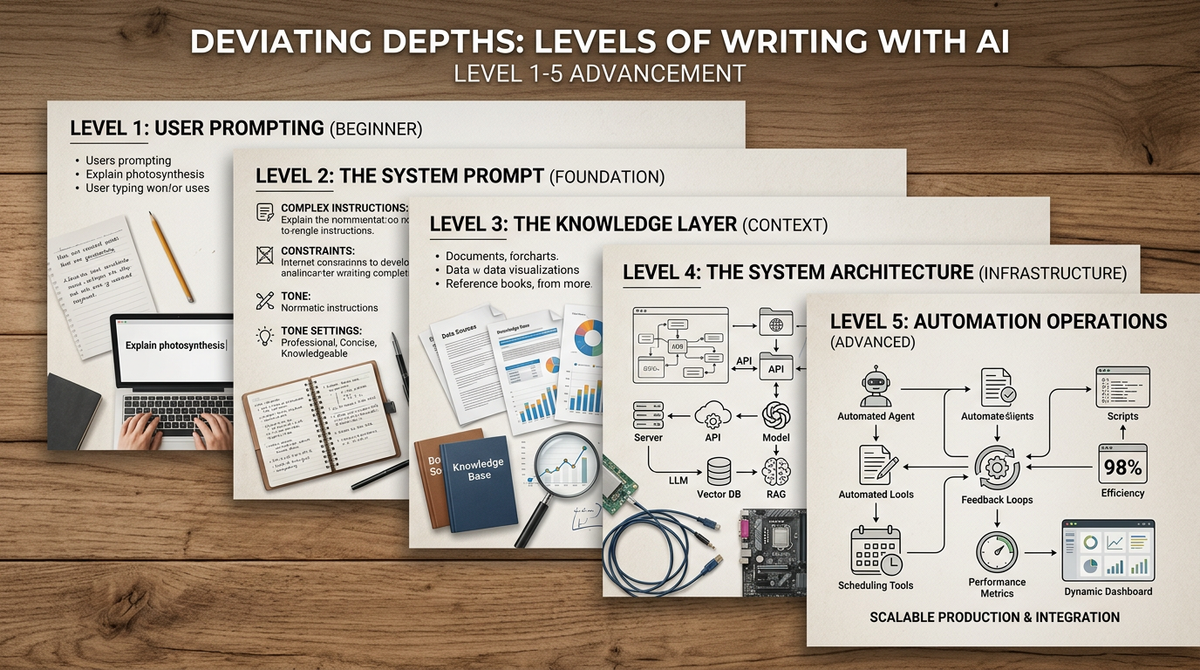
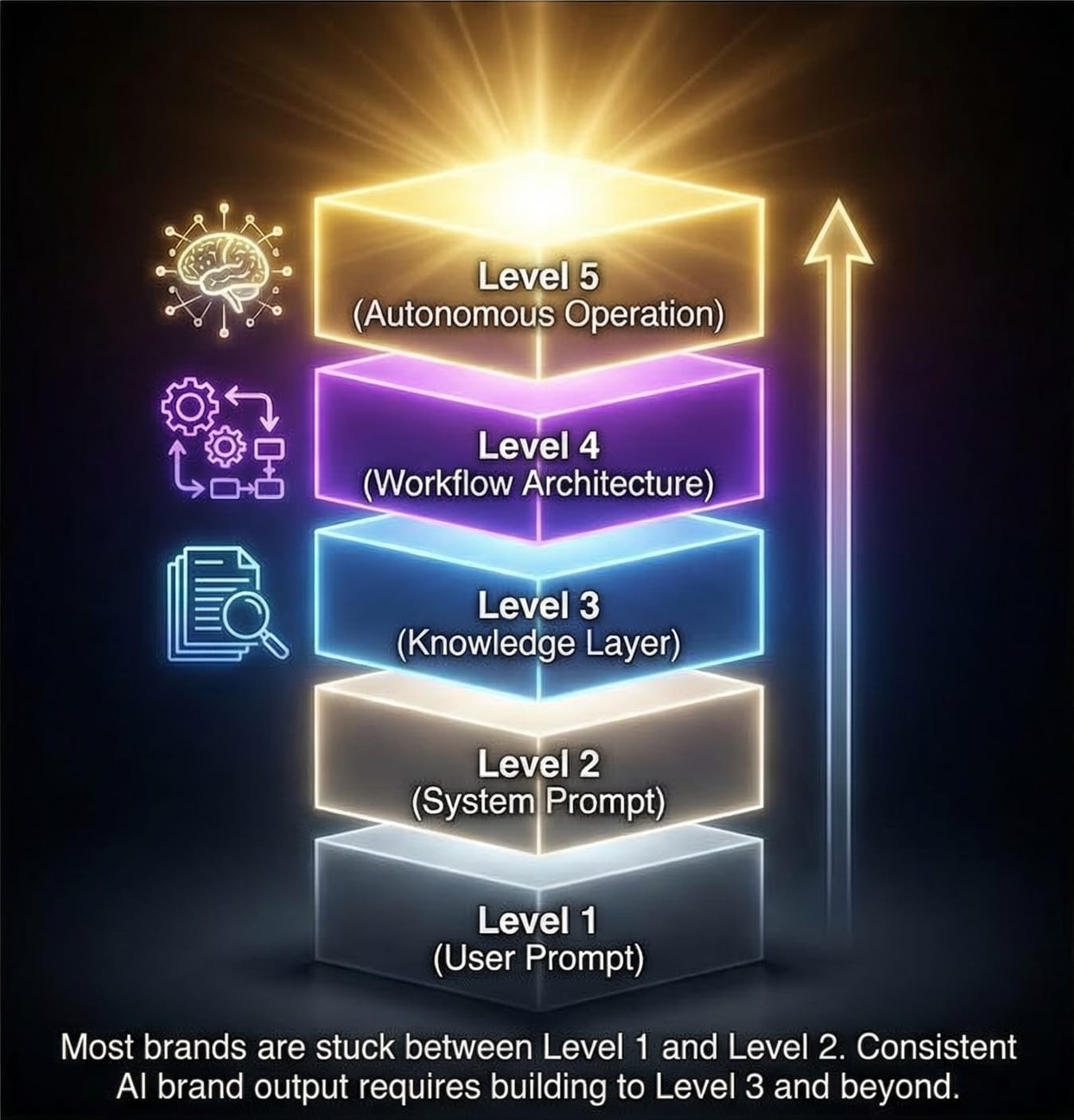
Most organizations are operating their brand AI at Level 1 or Level 2. The brands that are producing consistently on-brand AI content have, deliberately or not, built their way to Level 3 and Level 4. Here is what each level means and where brand consistency starts to become possible.
[INLINE VISUAL: Vertical progression diagram showing five labeled levels from bottom to top: Level 1 (User Prompt), Level 2 (System Prompt), Level 3 (Knowledge Layer), Level 4 (Workflow Architecture), Level 5 (Autonomous Operation). Each level illuminated with increasing intensity. Brand-relevant icons beside Levels 3 and 4: a document icon, a settings/workflow icon. | Placement: after paragraph ending "...where brand consistency starts to become possible." | Caption: Most brands are stuck between Level 1 and Level 2. Consistent AI brand output requires building to Level 3 and beyond.]
Level 1: The User Prompt
A single message. A single response. The AI is working from training data and nothing else. Brand output at this level is inconsistent by definition because the model has no brand context to work from. Every generation starts from zero.
This is where "write in our brand voice" lives and where it fails.
Level 2: The System Prompt
The system prompt adds authority above the user message. It is a set of standing instructions that shape model behavior before the user even types. At Level 2, you have defined a persona, established some rules, and given the model a basic frame of reference.
This is an improvement. But system prompts are still static and general. They can define how the AI should behave but cannot supply the specificity that brand consistency actually requires. You can say "be direct and confident" without the model knowing what that means in the context of your specific brand, your product, or your audience.
Level 2 is where most brand guidelines currently live. A paragraph about tone. A few adjectives. A list of words to avoid. This is the AI equivalent of handing someone a brand brief and asking them to write content they have never seen before.
Level 3: The Brand Knowledge Layer
Level 3 is where brand consistency becomes achievable.
At Level 3, the AI has access to specific, structured brand knowledge files: a documented voice profile with real examples, a personality and values reference, the actual vocabulary your brand uses and avoids, your known positions on the topics you write about, audience profiles, product context, and competitive landscape. Instead of inferring your brand from a few adjectives, the AI is reading your actual brand documentation.
The difference in output quality is not marginal. It is structural. The AI stops guessing and starts referencing. Outputs reflect your actual brand because the source material is your actual brand, not a general interpretation of it.
A brand kit at Level 3 is not a PDF that sits in a shared drive. It is an organized set of structured, machine-readable reference files covering voice, personality, vocabulary, audience, and the positions your brand holds. These are not written for a human to skim in an onboarding meeting. They are written to be directly referenced by an AI model at the moment it is generating content.
The average brand guidelines document was designed to be read by a human. AI systems need brand context structured differently: specific, categorical, and directly referenceable by a model without interpretation.
Level 4: Brand Workflow Architecture
Level 4 is where brand consistency at scale becomes operationally reliable rather than dependent on a single person's judgment about what is on-brand.
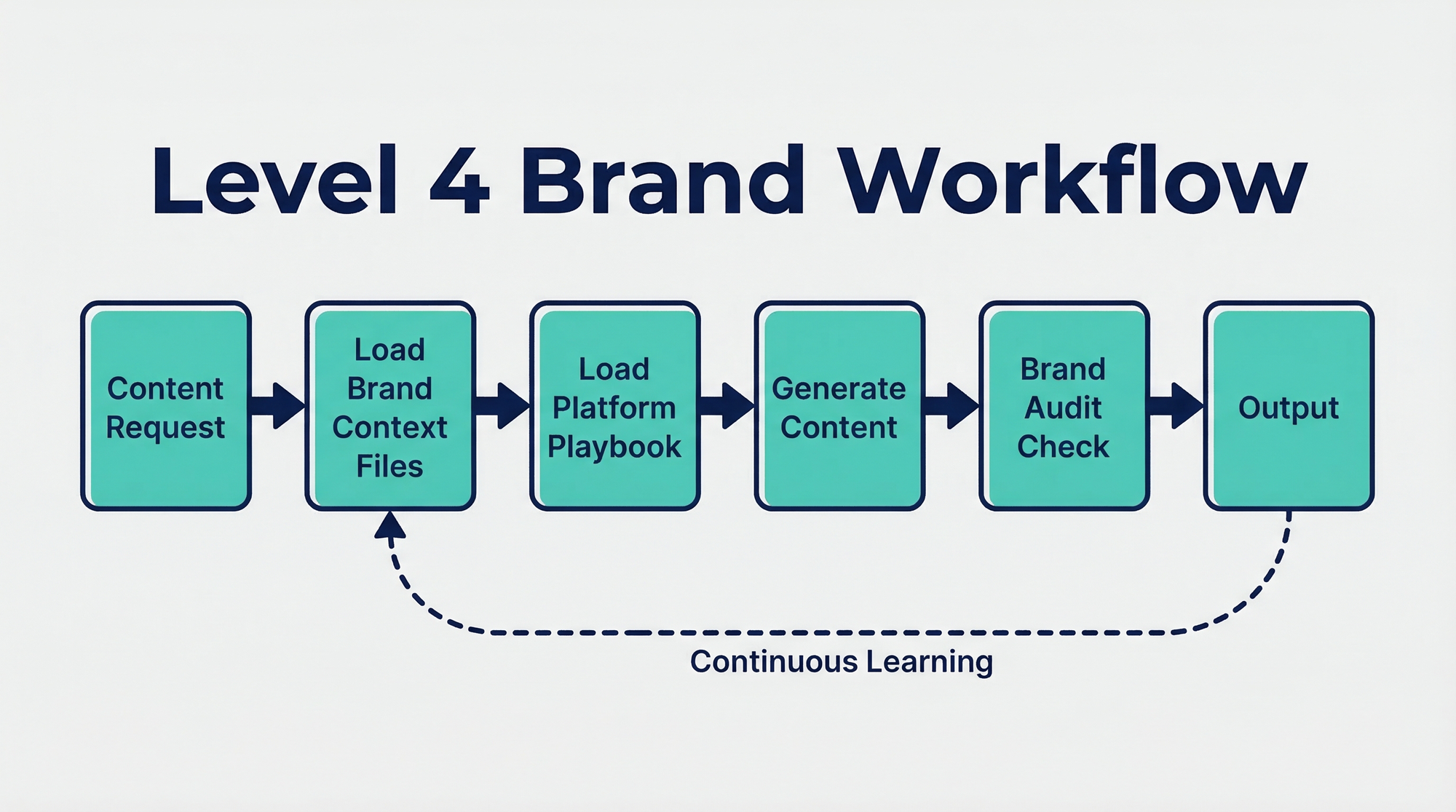
At Level 4, you are not just giving the AI brand knowledge. You are designing how that knowledge gets applied: which files are loaded for which tasks, what quality checks run after generation to verify the output meets brand standards, what happens when an output fails the check, and how feedback from your team flows back into the system to improve future outputs.
Level 4 is where the brand stops being something a person has to enforce manually and starts being something the system enforces architecturally. The brand context is always present. The rules are always applied. The checks are always run. Consistency stops being a function of who wrote the prompt.
Level 4b extends this with programmatic updates: as your brand evolves, as your team provides feedback on outputs, as you publish more content and develop clearer preferences, the knowledge files that power the system update dynamically. Your brand AI gets more accurate over time rather than staying frozen at the quality level of its initial setup.
Level 5: Autonomous Brand Content Operations
At Level 5, the AI is generating and managing brand content without a human in the loop for every task. Scheduled content, automated responses, regular brand audits of published material, all running on a cadence without requiring manual initiation.
The prerequisite for Level 5 is a Level 4 that you actually trust. Autonomous brand operations built on a weak knowledge layer and no quality controls will scale inconsistency, not consistency. The investment in getting Level 3 and Level 4 right is precisely what makes Level 5 safe to run.
What This Means for Your Brand Strategy
If your AI brand content is feeling inconsistent, the diagnosis is usually straightforward. You are at Level 1 or Level 2. Your AI has no real access to your brand context. It is interpreting a handful of adjectives and doing the best it can.
The path forward is not more prompting. It is building upward through the levels. Level 3 requires creating a structured brand knowledge base, not a PDF but an organized set of machine-readable brand reference files. Level 4 requires designing the workflow around those files: when they load, how outputs get checked, how the system improves over time.
This is not a technical project. It is a brand architecture project. The people who should own it are brand managers, not engineers.
Why Brand Kit OS Exists
Working through this problem personally is what led to building Brand Kit OS.
After rebuilding my own product from scratch and managing brand content across clients through the agency, the same pattern kept showing up. Strong system prompts. Detailed instructions. Adjectives and examples in the prompt. And still, the AI outputs were inconsistent in ways that were hard to pin down but immediately obvious to anyone who knew the brand well.
The problem was not that the AI was bad at following instructions. The problem was that the instructions were the only context it had. Every tool, every session, every new generation was starting from a handful of adjectives and a tone description that could have described dozens of different brands. There was no structured knowledge layer. No source of truth the AI could actually read and reference.
What was missing looked something like what you would give a new team member on day one: not just "our tone is direct and confident" but the actual examples of what that sounds like, the vocabulary the brand uses and avoids, the positions the company holds, the audience it serves and how they talk about their own problems. The kind of context that turns a generalist into someone who can actually speak for your brand.
Brand Kit OS grew out of that gap. The idea was to build a structured, machine-readable brand knowledge layer that any AI tool can reference when generating content, so that consistency stops being a function of who wrote the prompt and starts being something the system carries forward automatically.
If you are hitting the same wall with your own brand, it might be worth seeing how Brand Kit OS approaches the knowledge layer. brandkitos.com